A Unified Vision of Home in ‘All About Our House’

What makes a house a home?
Koki Mitani sets out to answer that question in his slice-of-life satire, All About Our House / Minna No Ie (2001). The story follows a young couple who buy a plot of land in the Tokyo suburbs and wind up caught between the whims of a traditional builder and modernist designer. This young family's siloed aspiration of a physical abode quickly becomes a pastiche of clashing domestic, platonic and occupational influences. By the end, however, the contractors’ combined impact proves larger than life.

A note on the director, Mitani: he is a luminary. He is well-known in his home country of Japan, but often only recognized abroad by his more internationally-acclaimed peers like Hirokazu Kore-eda, who recently inserted him into a segment of his Netflix production The Makanai: Cooking for the Maiko House as a sort of referential tribute. Called “far and away the nation's best-known dramatist” by the Japan Times, his moment in the limelight arrived on television via Furuhata Ninzaburo (1994 - 2006), the localized version of the American crime series Columbo (1971-1998).
Prior to that, Mitani had established himself in a popular form of theatrical performance known as Sho-Gekijo (Little Theatre). In 1983, he founded a troupe called the ‘Tokyo Sunshine Boys’. Some of its members went on to make great waves in the cultural meta, and two of them – Yoshimasa Kondo and Zen Kajiwara – make cameo appearances in Mitani’s early 2000s work.
All About Our House, unlike his previous projects, opens the blinds on Mitani as a person, as inspired by his own experience with building a home.The meta house story begins with Naosuke (comedian Naoki Tanaka), a writer for a daytime television show that runs weekly cookie-cutter skits of Kaiju creatures such as Godzilla hiding in apartments. Timid and golden retriever-like, his character couldn’t be more far removed from the Studio Toho properties on which he bases his sketches. He often finds himself occupied at the ear by an unrelenting amount of editorial calls prompting him to deliver the sketch of the week (inserted as several extra-diagetic sequences, culminating in a special cameo later in the film).
His better half, Tamiko (news anchor Akiko Yagi, in her film debut), is a music teacher, and it’s clear that she wears the pants in the relationship. Tamiko’s plans for their sanctuary are idealistic: she desires briskness and modernity, yet enough of a personal touch to foster future generations. She also becomes the crucial link between the builder and the architect, driving the bulk of the story by facilitating their conflict.
Seeking counsel on all things conceptual, she employs the help of her friend from college, Yanigasawa (frequent Mitani collaborator, Toshiaki Karasawa) – a furniture designer operating as an architect. He enters the screen as if conscripted by a cheesy rom-com about a Tokyo-based design firm that was not renewed for a second season. Karasawa’s performance channels the audacity of a classical musician, high-strung with unflinching perfectionism. His tendency to cite anecdotes about mid-century Modernism and Frank Lloyd Wright is often met with zero comprehension by the veteran handymen who are employed to build his structure.

The main contradicting force to this designer’s philosophy comes in the form of Choichiro (veteran Kunie Tanaka), a hibernating contractor and, conveniently, Tamiko’s father. He is pulled out of retirement for this role, to the slight dismay of the daughter but delight of his son-in-law. Mr. Cho must transform the sterling young man’s conceptual drawings into a tangible set. However, it is not him alone who is resurrected; he resolves to “bring the band back together” by recruiting former colleagues. The old man initiates the jubilant catch-up of his old company in the ground floor of a citizen center even before the contracts have been drawn up.
If it takes a village to raise a child, it takes a town to adapt the hodgepodge of blueprints and moodboards into its final form of perennial lodging. The group is certainly the right size for what very well may be the final hurrah in their twilight years of occupational design, but before they can lay down their tatami mats, they must weather the storm of a single architect.
The situation devolves like most of Mitani’s works, in which every character has their own agenda and itches to realize it. Mr. Cho is quick to brush over whatever Yanigasawa brings up during exploratory discussions that transpire between ambient corridors and pockets of jazz kissas, some of which the younger half had a role in designing. Their working relationship is barely mutual, and occasionally leads to subtle forms of sabotage.
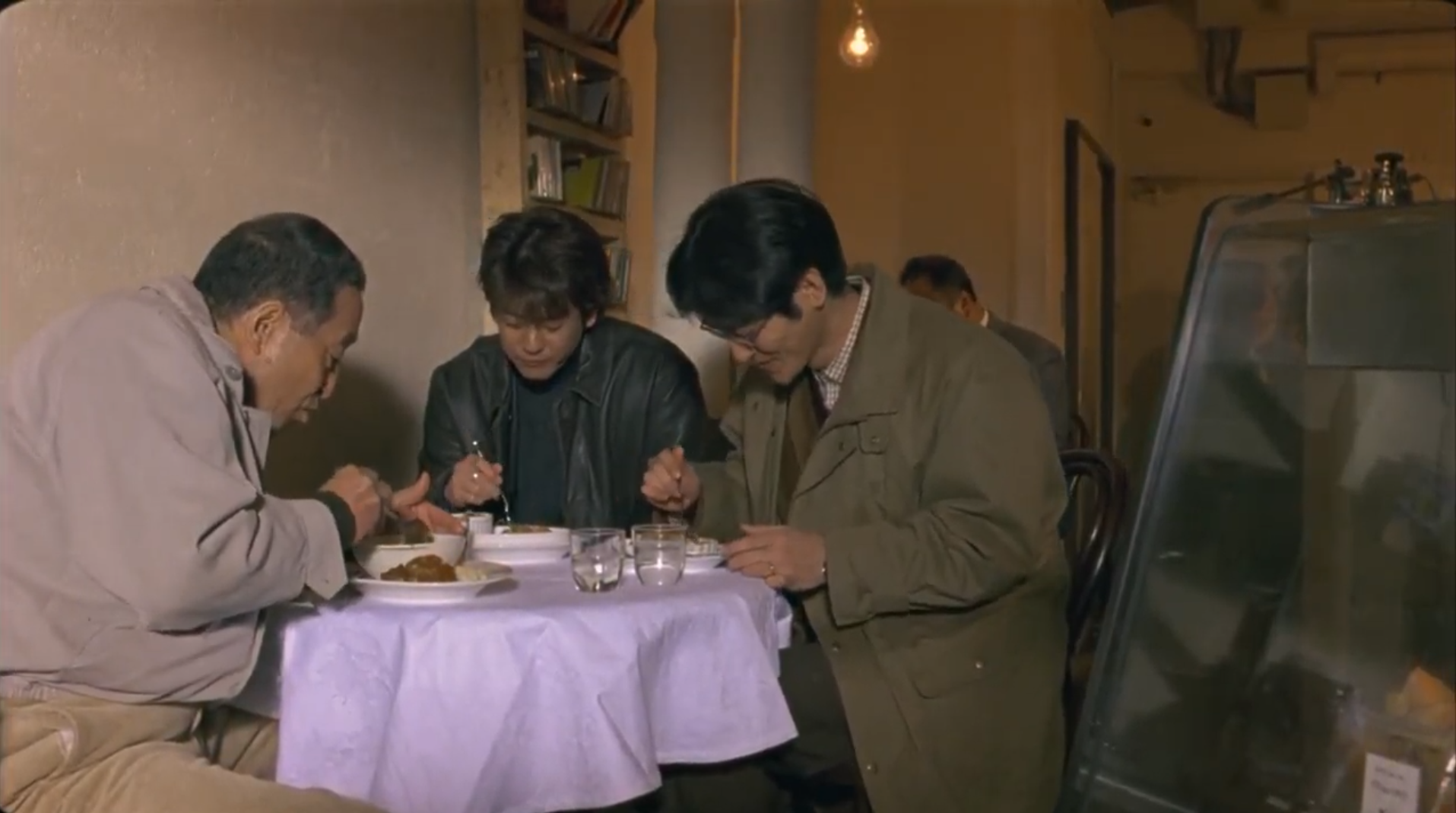
Meanwhile, the work meetings where the seniors assemble are even more chaotic in nature, often convalescing over spilled beer and shredded lettuce at a family hotpot. From the initiation into the process itself, we are given a glimpse into how differently the two mastheads operate. Only later on, toward the completion of the structural saga, do we see them step comfortably into the synergy of their converging Venn diagram, with Mr. Cho sitting down for a meal in one of Yanigasawa’s cafes. He mentions that he wants to use a takewari (bamboo split) tile – an obscure piece of old craftsmanship that the youngster had suggested weeks earlier. This conversation reveals an explanation of their tension:
“Predictable lives, predictable homes. I can’t stand them,”
says Yanigasawa, who regrets that there aren’t enough basics in this country.
The basics, in this case, are simple, endemic ideas imbued with the international space-making influences. This vernacular worldview is one that sighs at gentrified, clinically common-looking spaces, but its expression somewhat reconciles their differences: a passion for originality obviously unites them. There is nothing alien about the foreign, and nothing otherworldly about the endemic. But the context in which it serves people is what truly matters. The elder wants to push for the best, most stable pillar, while the younger wants to design a permanent space that reflects the personality of the people who carry it forward. By the end, the yin and the yang join, and its whole becomes that of the house. To mark the occasion, in an act indicative of the remembrance the space will carry, the two plant a traditional ink pot (Sumitsubo) at the upper interior of the finished roof – an ode to a similar artifact, discovered centuries later, that had been perfectly preserved on top of a historic gate at the Tōdai-ji Temple in Nara.

Kitani’s film perfectly cuddles viewers who value seeing growth on screen, which is significant for a barely two-hour film that does not possess the privilege of a multi-season broadcast. Here, the character who grows is an inanimate structure – an impressive material outcome of the human effort put into this narrative. What starts out as barren land is ultimately converted into a home whose style crosses Midwestern modern, Japandi and traditional domestic. By the wrap-up party, it looks like a page out of Architectural Digest.
Of a myriad of quirks that bless the screen, the tiny rituals the characters perform before the house stand out. These soulful gestures marking the milestones of construction have parallels with many other Asian cultures. Mitani always has a trick up his sleeve and his writing does not miss an inch (a measurement whose usage unexpectedly invites raucous debate during one notable scene).
There is a groundbreaking ceremony, carpentry rites, and before that, the roof-laying ceremony – with plenty of booze to go around. These moments and others convey what an endeavor this is for the central couple, who must withstand clashing, impassioned egos and exhaustive compromise in a realm far outside their comfort zone. For those months, their dream of a welcomed expansion teeters on the line of intrusion, and they remain suspended in a transient asylumship between home and construction site.
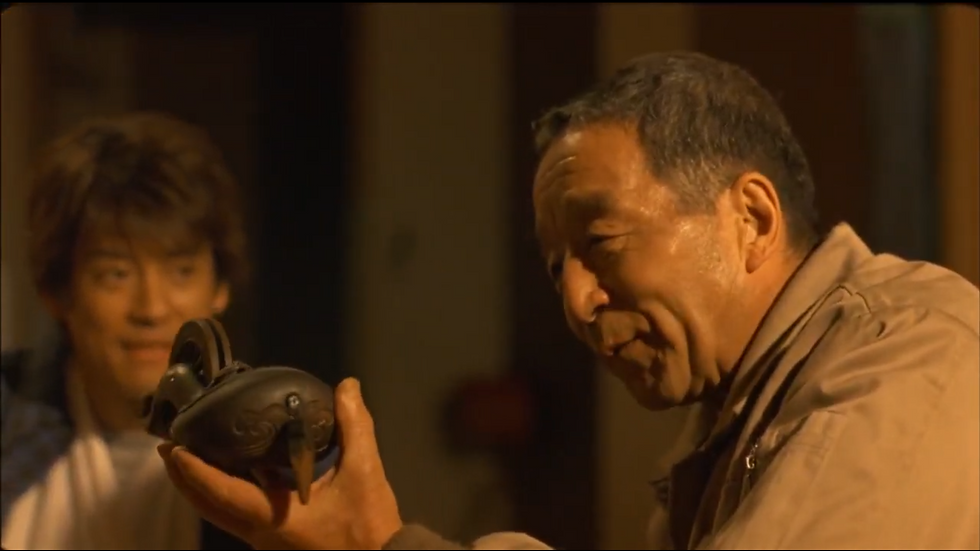
A concluding note must be added as tribute to Mr. Cho, played by the veteran Tanaka, who was born in the Toki District of Gifu to a family of Mino ware potters. While his legacy lives on in a different realm of media – as the direct inspiration for one of three admirals from Eiichiro Oda’s One Piece – this film feels like an especially full-circle moment. The casting of a man born at the foot of a persevering regional tradition, who then found his own artistic voice in the throes of a cinematic golden age is, like many choices in this film, intentional and venerable.
All About Our House is a love letter to craft, conflict and the sometimes quiet generativity that hopes to bind the old with the new. These contractors – the first dwellers on that concrete slab – provide the initial human touch in the forging of a home for generations to come.
-Chathuka


Comments