The Postmortem of Independence in Dharmasena Pathiraja's ‘Old Soldier’

There are certain challenges for those who operate in that space we call ‘Third Cinema’. Coined and ignited in the Latin American context, its dedication to decolonial thought and unvarnished social representation allowed for independent artists to unite across subcontinental boundaries. Late-blooming national cinemas left little inceptive ground for these filmmakers who wished to propagate a more conscious expansion of a medium that is traditionally relegated to host a routine cycle of bread and circus. At odds with prevailing cultural hegemony, it was often the individual who rose to reflect on immediate realities, thereby sharing in the universality of the human condition across their shared movement, and reasserting their local cinema in the process.
With this framing, it is Sri Lankan filmmaker Dharmasena Pathiraja whose stamp on Ceylonese cinema feels especially pertinent. Known primarily to audiences abroad for his 1978 social drama The Wasps are Here – the first South Asian film restored by the Asian Film Archive – his 1976 film Ponmani is just as remarkable for shedding thematic light on the North while crossing cultural and language boundaries unheard of for that time. The Kandy-born visionary’s films borrow from his foundations in academia, activism, documentary, theater and television, with Third Cinematic influences ranging from Fernando Solanas and Glauber Rocha to Satyajit Ray and Ritwik Ghatak.
Made in 1981, Old Soldier (සොල්දාදු උන්නැහේ / Soldadu Unnahe), fits jigsaw-like into the cultural meta of our times by virtue of its exploration of identities expressed under the climate of a postcolonial, structurally hostile urban complex. The film spreads itself across the eve, dawn, and postmortem of Ceylon’s celebration of independence from the British in 1948, and the symbolic breaking away from the chains of a centuries-long, Tripartite colonial rule. ‘නිදහස / nidahasa’ – or the Sinhala word used in reference to the holiday – translates literally to ‘freedom’, which further drives the root of personal agency in the piece. Pathiraja captures the mood of the day in Colombo, the island’s coastal capital since 1815.
A chequer board of multi-disciplinary celebrity entities (Joe Abeywickrama, Henry Jayasena, Malini Fonseka and Neil Alles, with Premasiri Khemadasa on score, are all known for foundational contributions to their respective disciplines in Ceylon’s cultural history), form some of the enduring anima and ensemble representative of a Pathiraja film. Despite its stacked talent, the film itself is quite the material anomaly, with a decent copy being virtually unobtainable till recently.
Squeezed into a room on the suburban fringe of Havelock, I was able to watch the film in three oddly dissected parts, projected in a quasi-living room when only fourteen others on the Four Favorites app had logged it. The day of the Collective for Historic Dialogue and Memory (CHDM)-hosted screening was the 5th, the holiday’s morrow. In a standard household, it’s a day when national flags are put away in Almirahs and pedestrian life presumes. The masses, having been attenuated by a military broadcast the day prior, now board the regularly sardine-packed buses to an equally droning wall of noise. In the film, however, we are taken outside domestic associations with the jubilee and into a grassroots dissection of whether the celebration rings true in contemporary urban life. Pathiraja’s focus falls on four protagonists who fall outside the institution of the common citizenry, and whose experiences of the day directly reflect the disconnect between the adulation of independence and the absence of personal liberty.
His quartet of characters are all drifters, just barely clinging on to the social fabric of Colombo. Once upon a time, they occupied the roles of serviceman, salaryman and housewife, setting the ground for a two-tonal system: one of familiarity, still identifiable with the general public and oneself, and simultaneously one of social remoteness, in which very different circumstances of the shared celebration – not at all celebratory for the film’s subjects – can be observed.
With the contemporary audience inserted into this historical theater, ties between the past and present emerge, including resounding ideas of sovereignty, individual autonomy and the banality of the government-mandated holiday; commentary that has aged remarkably well.
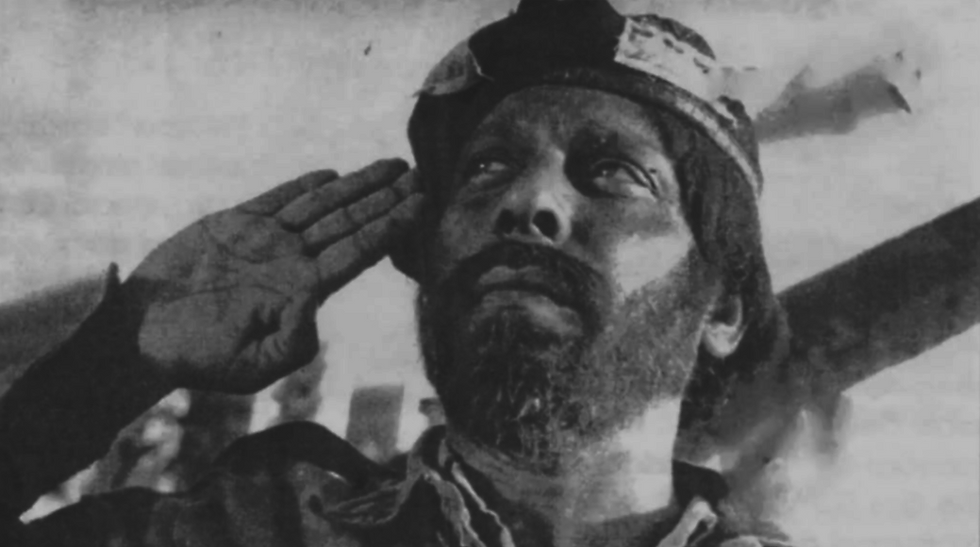
The titular old soldier, played by Joe Abeywickrama, is a man enveloped by his own post-war trauma and disordered identity. Hailing from a generation who witnessed the end of the British Raj and who warred in the effort to end all wars, the character is plagued by visions of oncoming attacks by foreign forces, disjoined from the martial heroism of the ‘Ranaviru / රණවිරු’ persona [1] popularized during the Civil War (1983-2009). Pathiraja is concerned with a more realistic depiction of the veteran ruled to serve a conflation of past and present. Surrendering his individuality to the army leads the soldier to interbreed motivations of the state with his own, completely conceding any internalities or semblance of independent thought.
There is a strong culture of care for disabled veterans in Sri Lanka even today, but mental health issues tend to fly under the radar. The soldier hasn’t given up an arm or a leg, but he has left behind his village, the woman he hoped to marry, and any sense of tether to those olden communities. In an unwelcoming capital, he is economically and communally disenfranchised, and patriotism (දේශප්රේමය, a literal conjunction of the words for nation and love) is the only form of love that he can hold onto – a road that, again, leads to none at all.
The delirium extends beyond the individual, however, and into a subjugative state of mind, one which bled its way into later Ceylonese media movements. Pathiraja told this tale right before the onset of a more nationalistic exploitation of the arts and a compounding of censorship, an era when artists were pushed into a soldier-like state of hallucinatory indetermination. In an economy so accustomed to the rationalization of the atrocious, is there ever space for total peace? A structurally violent society is a tight-hugging bracelet for the soldier along each step, far beyond the days of actual bloodshed.

The conditions don’t seem any brighter for his vagrant compatriots. Just like the soldier who refuses to abandon post, Willie Mahattaya / විලී මහාත්තයා, played by Henry Jayasena, is a man whose uniform is stripped with the marks of its identity still intact. Following the revelation of an extramarital affair between his spouse and employer, Willie acts in a moment of rage and slaps his boss, bringing upon circumstances that force him to relinquish control once held over office, matrimony and home. Deviation on the side of Willie’s patriarchal wage-giver and the maternalistic consort creates disorder for the man who only finds emancipation in maintaining a symbiosis between the two boxes. He is still referenced and identified with ‘Mahaththaya’, an honorific that puts him a line above the regular proletariat, but that too is a shell, and borderline satire for those listening to his woes in the bar that he has made a third space, to make up for the absence of his first and second.
Third spaces play a key role in the film, and Pathiraja thus employs the cinematic form as an anthropological document, echoing parallel cultural movements like Flowers of Taipei despite the two operating in separate spheres of influence. Our characters rendezvous primarily under the shade of a Nuga tree overlooking the ocean. Nowadays in Colombo, you can still see doorless couples lounging under umbrellas, tuk-drivers congregating in stands and people sniffing out a cigarette at tea shops at routine times.
However, this makeshift resting place is sadly the extent of what our characters can call home. The location neighbors the historic Colombo Lighthouse, which Pathiraja captures mere years before its Naval assimilation and consequent restructuring during the Civil War. The tower itself is almost unchanged from how it appears today, but the parallel beach – where the old soldier does his morning marches and where Willie washes away his sins from the night before – is now inaccessible to the public. Within the confines of the film, the elevated monument provides a deep contrast to the lives being played out beneath its footing; analogous with the form-over-function, impositional artifacts in today’s capital, pictured within the same frame as underserved settlements.
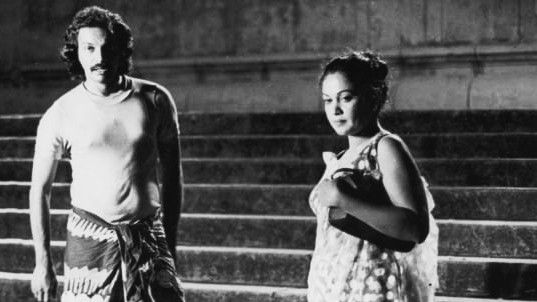
The lighthouse and its emblematic stairs are also where we meet the second half of our quartet: the pimp, Simon Ayya / සයිමන් අයියා, (Neil Alles) and Prema Akka / ප්රේමා අක්කා, a sex worker (Malini Fonseka). The former is the most elusive in terms of general pretext. Alles, as a veteran theatre practitioner, brings Simon’s precariat to life with a more physical performance. We get a clear window into the earlier days of the lighthouse platform itself in a long take of him peddling a group of foreign tourists (in a solicitation of just a hundred rupees, less than one third of a dollar today). A later chase scene across the Fort area, also provides an exhaustive bookmarking of the pre-development streets of the times. In pursuit of that hundred rupee bill (which, too, gets split three or four ways in the trade), Alles projects a pedestrian view of the city, but extends it to that of the ground-level grifter who must regularly resort to felony to sustain his material and social reserves.
Prema Akka was forced into the trade after her husband’s hospitalization and subsequent eviction alongside two young children. Much like Willie, she hails from an urban middle class more accustomed to the homebound leisure identified with one of the twenty-five-or-so Sri Lankan holidays made accessible to the public. Even with the insufficient traffic of the day, there is no rest from a routine of ritualized labor, and no recess from her and Simon’s codependent means of survival.
Fonseka’s charismatic sanguinity cuts through the resigned and apathetic caricatures around her, as she maintains strong autonomy over thought despite having to charter agency over her body in an unrelenting trade. The exploration of single motherhood here also mirrors a side plot in the recently restored Sumitra Peries’ film The Girls (1978), and seemed to be enough of a social issue to find itself frequently reflected within that generation of left-leaning directors.
Prema continues to push through an androcentric gaze, volatile clientele and a surveilling police apparatus (all very tangible harms), and gives up an integral part of herself in that process, all in order to feed her children. There is a material struggle to all of them, and the film doesn’t shy away from illustrating this in flashbacks; the soldier wanted to join the army for a good salary, while Willie is blinded by his determination to procure jewelry for his wife. Simon, in the present moment, thieves his way as a means to survival. But what differentiates Prema is her obligation to motherly care, which constrains and directs her motivations. Through these cases, Pathiraja presents something of a microcosm for the middle-class family where there is often an asymmetrical maternal obligation, with a dependency on the structure to remain undisturbed.
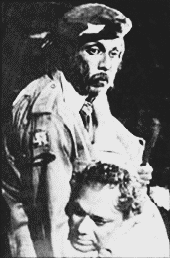
Besides the obvious trade connection, Prema’s role within the group is largely complementary to that of Simon’s. Containing most of the agency on their half, the two act as de-facto parents: Prema initiating Willie into the group after finding him drunk and despondent, and Simon feeding the group despite his day of personally slow business. There is notable solidarity within the group in action and shared grievances, further indicated by the nuclear nomenclature of Ayya (older brother) and Akka (older sister).
The asymmetry within Simon comes from his mostly static role; he is the enforcer, promoter, and insurer, yet it is through Akka that the business originates. Without her clientele on the streets, Alles is drawn into the same streets’ barbarisms of kidnapping and stealing, ultimately landing her and Prema in the back of a police van, splitting the group cleanly in two like a scored pill towards the end of the film.
The ending insinuates that the characters remain untethered to any community more micro than the city itself. We never see the family trees of any of the four, and their reference only arrives through the telling of a tale that barely manifests onscreen. In the absence of a safety net or an interdependent entity to care for them, the alienation from the state proves pungent for our characters – even Soldadu Unnahe, who, in his final monologue, denounces his doctrinaire belief in the state. For generations still untangling the ropes of a colonial past (in addition to the long-standing illnesses of patriarchy and militarism), independence may be too abstract to actualize. While the festivities persist, the philosophy of the holiday remains at arm's length, materializing in celebratory monuments and annual parades rather than manifesting in individual lives.
Pathiraja’s film underpins the flailing banality of the climate under which we continue to celebrate the holiday. Its most novel faculty lies as a reference point for future generations: the presentation of issues in Ceylonese society as part of a latent hangover from the postcolonial rather than one insular to the self-contained occurrences of the present generation. Creating the space for the recognition of these social patterns within Sri Lankan cinema allows for the Third Cinema conscience to live beyond the theatrical run. Old Soldier is an achievement in postcolonial cinema that will only continue to grow younger with time.
Citations:
[1] Kahandagama (2014), Victorious Soldier : Portrayal of Militarised Masculinities in Sri Lankan Sinhala Pro-war Films
-Chathuka


Comments