Budding Talents Reap What They Sow in 'Magic Farm'

This past weekend, I finally made good on a longstanding request by our editor-in-chief to attend a film festival here in Chicago, whose cinematic offerings I have not taken proper advantage of. The city was home to MUBI Fest for two lovely days, and I elected to see the premiere of Amalia Ulman’s Magic Farm at The Music Box Theatre.

Magic Farm follows an incompetent crew of Brooklyn influencers who accidentally wind up in a small town in Argentina while trying to film a documentary about a viral dance trend. When they realize their mistake, they decide to manufacture a trend among the locals. The film has grown on me the more I sit with it - there’s a meandering quality to it that’s present in most indie dramedies that initially had me feeling lukewarm. However, Ulman (who also stars in the film) both lampoons and humanizes her cast of self-important trendsetters in a way that shows she’s tapped in to the milieu she’s capturing.
The group of influencers, led by the disillusioned Edna (Chloë Sevigny), find themselves in the wrong San Cristobal due to a fuckup on the part of Jeff (Alex Wolff). It becomes quickly apparent that their hearts aren’t in the job. Sevigny has a smaller role in the film despite being its biggest name, which really allows Ulman and newcomer Joe Apollonio to shine. Ulman’s character Elena is the only Spanish-speaking member of the crew and, alongside Edna, is the most competent, while Jeff and Justin (Apollonio) are content to half-ass their duties as they develop relationships with town residents.
What Ulman really succeeds in capturing is the lobotomized way these VICE-style influencers and their audiences interact with and view the world around them. They come to Argentina to capture an inane dance trend, and when they realize they’re in the wrong place, they decide to make one up because that’s what’s engaging to them and the people who watch them. The light tone of the film belies a commentary on how these types of journalists view foreigners through an exotic lens and force their preconceived notions onto them for global consumption (and money).
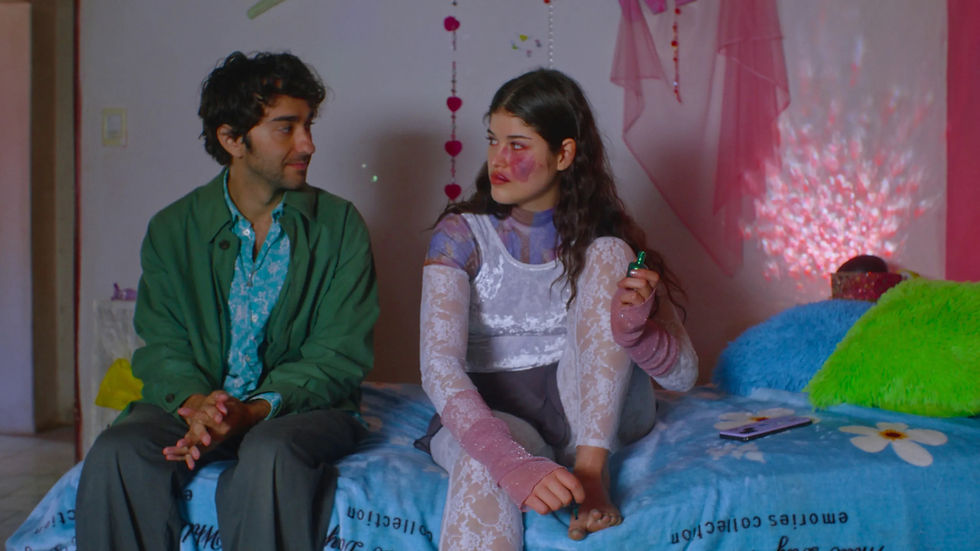
Throughout the film, the effect of the harmful herbicide glyphosate on the local population is directly shown and referenced. It has caused mild to severe birth defects in many people in the town, including the daughter of one of the residents, who Jeff (ever the fuckboy) begins hooking up with. If they had any genuine curiosity about the world and people around them, or a connection to those things that didn’t hinge on exploitation, they would see the situation as a meaningful journalistic opportunity (something Edna could do with).
Instead, they trudge halfheartedly through the motions of auditions and filming their fake trend, which is about people dancing with bows on their head (the explanation for the trend being “we’re all a gift from God”). It’s so patently manufactured, and the final filming scene is disrupted by a low-flying plane spraying glyphosate as if to shout “This is what’s real!” When it’s time to pack up, nothing of real note has been accomplished by the group, although some of them have had their little dalliances with the townsfolk, with bittersweet results. Their self-involvement prevents them from seeing the humanity around them while on the job, but after-hours they have no problem getting close with the locals – before leaving them high and dry. Magic Farm is the latest in an intriguing microgenre of MUBI films (see also: Azor (2021) and Pacifiction (2022) that involve interlopers engaged in some discreet form of neo-colonization, but gives it a decidedly indie-dramedy twist.
-Nick


Comments