In Between the Negatives: Vikas Urs on Cinematography and Preservation

Updated: Aug 6
This is the second part of In Between the Negatives, a series based on research compiled by members of the Arkebara Collective, a group exploring film preservation realities and challenges in the Majority World. My focus is on the Indian independent context. The first segment explored the perspective of Ranjan Singh, a producer on Tiger's Pond (2025).
Vikas Urs is an Indian cinematographer who works in independent cinema. Rather than referencing other films or visual material, he builds his approach to each project from lived experiences, personal artistic instinct, and immersion in the story and its locations.
Tiger's Pond is an independent Kannada-language production, shot on 16mm in 2023. Filmed entirely on location in a remote village in the interiors of the Indian state of Karnataka, it was Vikas's second collaboration with director Natesh Hegde. Their first film together, Pedro (2021), is part of the same spiritual trilogy.

The Film Ecosystem in India

Vikas offers a working history of the Indian film processing landscape that is relevant to understanding what remains today. Film Lab India, in Mumbai, was essentially Fuji's lab in the country, with Mr Sanjay Patel as Fuji's longtime distributor. Kodak's own Mumbai lab closed around 2014. Prasad Labs operates in both Chennai and Mumbai; AdLabs also processed film in Mumbai.
Manmohan Shetty, founder of AdLabs, made many mainstream films possible while also paving the way for filmmakers of Indian parallel cinema such as Mani Kaul and Shyam Benegal. He offered limited financial support as his way of giving back to the medium. Shetty later moved into running an amusement park; the lab space passed to Reliance, where he consulted for a few years, before eventually closing. In that time, everything had moved from film to digital.
The 16mm camera infrastructure in India is thin. Aamir Khan Productions' Arriflex 416 Plus – the body used on Tiger's Pond – is, to Vikas' knowledge, the only one of its kind kept in active production use. Raam Reddy owns two personal 16mm cameras. Amitabh Singh owns an SR3. The Film and Television Institute of India (FTII), in its inventory, has an SR2 for student exercises, with a possible SR3 and a 416, and a 535 at Satyajit Ray Film and Television Institute (SRFTI) in Kolkata.
Vikas is of the belief that we need to collectively push new practitioners as well as seniors to shoot on film. Since Tiger's Pond, Vikas was happy to count roughly four to five features shot on film in India, despite any critical conversations around the creative aspects which will happen regardless.
"The infrastructure of film to work can only happen if people constantly keep shooting on film. It can't be a one-off thing."

In a way, shooting on film never stopped in India. Gaurav Madan, one of Vikas’ recent collaborators, shot a film on 16 mm called Barah by Barah in 2017-2018 with cinematographer Sunny Lahiri. It was processed in the pre-COVID pipeline when things were marginally better, while Kodak was still managing the lab in its entirety. A few music videos and some one-off features every few years kept film alive, though still not quite active enough to sustain an end-to-end infrastructure for processing. Another unreleased 16 mm film shot in 2018 to 2019, called Versova, was shot on an SR3 with B&W 7222 stock. It was processed at FTII, which was the only B&W lab in Asia for some time.
The recent lineage runs from Jugnuma: The Fable (2024), which preceded Tiger's Pond, and on to a current project on 16mm film by cinematographer Pooja Gupte. Vikas also notes that cinematographer Satyajit Pande (known as ‘Setu’) had done some tests on film for Laal Singh Chaddha (2022) and had considered shooting it entirely on film. While not trusting FilmLab at the time, he considered sending stock to Kodak London for processing.
Although cost and scale ruled it out at the time, seeing Tiger's Pond come together a few years later gave Setu more confidence in the Indian pipeline. That said, by the virtue of it being an independent film, the ecosystem could remain smaller, as opposed to Lal Singh Chaddha as a a mainstream film with a big budget.
Vikas' own FTII batch (2011–2017) was among the last trained fully on film and the first also trained on digital. He was involved in a few institutional firsts along the way, including the making of the first DCP from a film negative, the first B&W optical print at FilmLab. Working with both film and digital, he was also among the first to unbox the Alexa Classic when it arrived at the institute. His own diploma film, shot on digital, deliberately mixed archival footage, low- and high-res Beta and smartphone footage with the Alexa.
Pedro vs Tiger's Pond – Format, Treatment, and the Decision to Shoot on Film
The intention to shoot on 16mm predates Tiger's Pond. Vikas and Natesh had discussed shooting Pedro on film but held back due to expected monsoon conditions of the exterior shoot and a very limited budget. They also hadn't shot a film between them yet and thus hadn't built the trust that the added complexity of shooting on film would demand.

By the time of Tiger's Pond, the duo’s working relationship was established, and the film's treatment suited 16mm more explicitly. "Tiger's Pond is naturalistic lighting but more stylized in that sense – which could benefit from 16mm filmstock's texture," Vikas says. "The specific colors and contrasts created with it are intentional and were all decided during prep."
The two productions also differed in ways that bore directly on the format decision. Pedro, for its part, used non-professional actors in a heavily verité, long-take approach. Its first shot ran 7.5 minutes, which, on a 400-foot magazine (roughly 11 minutes of runtime), would have put real strain on any actor to sustain. Additionally, non-professional actors can't reliably repeat a performance across takes, which shaped Pedro's rhythm and made its camera approach largely reactive. Tiger's Pond, with professional actors and a more controlled environment, could sustain the discipline 16mm asks for.
"I also told Natesh that you might imagine 35 in your head, but the choice of medium should first resonate with our idea, and second, it has to function within your budgets. Even to raise the budgets for Tiger's Pond was so difficult – it was really Herculean."
On the question of actors, acting, and the shooting ratio that film enforces, Vikas takes a nuanced position. He notes that contemporary mainstream industry practice relies heavily on digital's capacity to keep rolling, which shapes not just how films are made but how actors approach their performances.
Economics of Shooting on Film
Ahead of the interview, I independently compared the cost of Super 16 to digital and found them broadly comparable at the time Tiger's Pond was shot in 2023.
"I found it close to shooting on an Alexa Mini with a Cooke lenses package," Vikas notes, adding that prices have since risen along with the dollar and the cost of Kodak stock. Monsoon Color Lab has since taken over from Film Lab and published its own workflow ecosystem with updated pricing.
On the question of format economics more broadly, Vikas is direct:
"Shooting 35 is going to be four times the cost of 16. It's clear math. And that was one of the reasons we considered it and dropped it right away. I wouldn't recommend 35 for independent films unless you have really good funding."
He believes the resurgence of film in India can't rest on independent productions alone: "Producers need to do the negotiations with the lab, the scanning, the grade, arrive at costs which are receptive, talk to Kodak, negotiate. Because we as independent filmmakers are not invested in the industry's well-being in that way." He's glad that producer Ranjan Singh became more open to shooting on film by the end of the project, and sees that shift as significant.
Tiger's Pond had an unusual financing structure worth understanding on its own terms, since it shaped what the production could and couldn't do. The original producer, Rishab Shetty, had also produced Pedro and took considerable convincing to shoot on celluloid; once he agreed, the budget was fixed.
"The film got completely made – production was complete, film was ready, when we received the Berlinale premiere invite. After the invite, there were some changes we wanted to do with the edit and do the final song. Rishab was not in a position to support it further. That's when Ranjan and Anurag came in to give that little support financially for the last bit and extended their support to take this film forward."
TECHNICAL CONSIDERATIONS for tiger's pond
Film Stock Selection
Three stocks were chosen for Tiger's Pond: Kodak 200T, 250D, and 500T. The decision wasn't purely aesthetic – it was shaped simultaneously by on-location testing, scanning requirements, and the need to future-proof the film for eventual streaming distribution. Scans were tested at 4K 16-bit, 4K 12-bit, and 2K 16-bit before the team settled on 4K 16-bit to secure the film's longevity across distribution formats.
Vikas' original plan was to shoot everything – day and night – on 500T. That changed after camera tests on location in Natesh's village.
"I realized that 500T, being a tungsten stock, picks up a lot of grain in the daytime – especially in the mid-tones and highlights. As a result, 250D became the primary daytime stock, 200T was chosen for most night work due to its finer grain structure, 500T was retained selectively for scenes where the heavier grain quality served the emotional texture of the image."

The revised strategy held 500T as the original test stock, retained selectively where its grain character served the story; 250D became the principal daytime stock for its finer grain; and 200T became the principal night stock, chosen specifically for deeper, cleaner shadows in forest scenes. Vikas is clear that the resulting variation in grain density across the film is intentional, not incidental – scenes where stocks shift are therefore creative decisions, not inconsistencies.
He also generally overexposed by 1/3 stop, and in some cases by a full stop, for certain scenes – again, a call made in response to the on-location tests rather than pre-planned – staying consistent to his approach to cinematography.
"Overexposure preserves your shadow detail when needed when shooting on film," he says, "and also helps control grain."
Equipment
Tiger's Pond had a 5:1 shooting ratio, which came to a grand total of 60 cans of film. The number was a creative and budgetary choice, but it was also fixed by the pipeline itself: because stock has to be pre-ordered from Kodak well in advance, the total quantity was locked in long before filming began, turning a logistical constraint into an aesthetic one. It's an invisible detail to any future restoration technician working only from the negative.
The production shot on an Arriflex 416 Plus sourced from Aamir Khan Productions, along with S16 and S35 Ultra Primes and a Canon 10.6–180mm zoom. The camera and lenses hadn't been used in some time, and preparing them alone was a significant challenge. ARRI was contacted for parts but could not assist, and there is currently no active servicing infrastructure for the Arriflex 416 in India.

The team improvised extensively with help from Mr Kamal Kadwani, who has run a camera service and repair store in Mumbai for the last 35 years. With his help, the camera crew was able to procure connecting cables, replace the existing clamshell monitor which was 360i to a 5-inch Blackmagic onboard monitor and onboard batteries, and also clean the mirror in the reflex viewfinder.
While the crew was able to efficiently work around the resources available to them and make the setup work, their solutions in doing so points to a critical infrastructural gap: the entire production depended on a single camera body with no repair ecosystem in India to support it.
Crew
The camera department was a small team: Vipin Waghmare, chief AC, who also co-managed stock logistics with Vikas; one intern, who handled the transport and logging of stock; and Anil Dhuri, from Aamir Khan Productions, the chief camera technician who came with the camera. Anil Ji's presence is worth noting as an example of how vendor relationships function in Indian production.
"Unlike what happens in the West, in India it is collaborative in that degree – the equipment is hired from the vendor, the vendor's people come to the shoot. Anil Ji is the person without whom the camera is never sent to any production."
He handled daily maintenance – loading and unloading magazines, cleaning the gate, dusting and securing the camera – and after each exposed can was unloaded, sealed, and marked, Vipin would sign off in a register. And in this process, two camera attendants assisted him.

The Pipeline — Building the Ecosystem
Assembling the production pipeline took roughly six months of pre-production work, coordinating between multiple entities across India and abroad: Kodak India, which supplied the pre-ordered stock; Film Lab India, which processed the negatives; Prasad Labs, Chennai, which scanned them at 4K 16-bit, handled color grading and the DCP; Kodak London, which provided QC on the scans; and Aamir Khan Productions, which supplied the camera and Anil Ji.
"We put together people from Kodak India, Film Lab and Prasad Labs in Chennai to streamline the process," Vikas says.
"We pre-ordered our stocks through Kodak India much before the filming process, as it takes time for the fresh batch to be custom made in Rochester, New York, and to be imported and delivered to our shooting location."
Vikas is emphatic that the relationships he navigated through this process mattered as much as the technical pipeline itself. Mr Suresh Iyer, Head of Sales at Kodak India, connected him to Mr Antonio Rasura, Technical Head at Kodak UK, who gave crucial technical support on the stock. Mr Rajesh Jiandani – ex-MD of Prasad Labs Mumbai, and formerly Head of Sales at Kodak India was instrumental in organizing the pipeline across institutions.
When a production places a fresh order, Kodak doesn't supply from existing inventory. It manufactures for that order specifically.
"What Kodak will do at the back end is take your requirement, and it will make jumbo rolls of 50D, 250D, 200T, and 500T. What it is essentially doing is taking a batch of the jumbo roll and making it into 400-feet cans. And it is also segregating the 400-feet cans and numbering them batch-wise."
Ideally, all cans on a single production come from the same batch, for consistency of grain and color response; older, cold-storage cans carry a higher risk of fogging. At FTII, Vikas recalls, student productions would sometimes get a single free can from a Kodak or Fuji rep – but it would often be older vault stock, requiring a fog test that nobody wanted to pay for.
Because of budget constraints and the remote location, cans could be dispatched to Film Lab only about once a week at roughly 10 cans a batch. Processing turned out to be unusually consistent, partly by circumstance: two other productions were shooting on film around the same time, in March 2023: a British 35mm production called Sister Midnight, and a second, unnamed foreign 16mm production shot in Delhi.
"So I got very lucky because the lab was continuously up and running. The negatives have to keep processing constantly which means the chemicals don’t need to be refurbished so often. If the chemicals remain stagnant for too long, then your processing goes haywire. They were replenishing the developing tank, the fixer and the stop bath as there was a volume of work coming in, making the processing very consistent," Vikas says.
Film Lab Mumbai had a dedicated and veteran team: Manager Mr Raju Shah; Lab In-charge Mr Abhay Mhatre; Processing In-charge Mr Dalment Peter, and Negative Assembler Ms Ujwala Kale. They ensured excellent and timely processing along with QC checks. These QC checks helped when the processed negatives were sent to Prasad Lab, Chennai for the scans and cross-verified with Kodak, UK.
All 60 cans were scanned at Prasad Labs, Chennai, under Chief Scanning Technician Mr Srinivas Rao.
"For future proofing and for the OTT, we decided on 4K 16-bit. With a 4K 16-bit scan, we could always make 2K outputs. With a 2K scan, you cannot extrapolate to 4K – unlike digital, where you can algorithmically upscale."
One 400-feet can (about 11 minutes of footage) works out to roughly 1TB at that spec – around 60TB of raw scan data across the whole shoot, plus a full backup copy, stored on a RAID setup (6 drives, 12TB) that Prasad Labs Chennai recommended and procured, at a hard-drive cost of ₹ 8–9 lakh (roughly 8500 USD). There was no data wrangler on set; the closest equivalent was the team of Vikas and Vipin who labeled, stored, sealed, and dispatched the cans themselves.

Two light-leaked cans went through restoration at Prasad Labs, Chennai and were reviewed remotely by Vikas, who provided correction notes. The leak showed up as a pulsating movement through the affected frames along with red chroma on one edge of the negative. The fix combined digital masking and frame replacement (mapping image points across frames and filling the masked area with duplicates, a practice that is more effective for static shots than tracking ones) with a color-grading correction for the red chroma, handled later during the Mumbai grade.
Three shots were restored effectively enough that they wouldn't be visible to viewers; two received a partial fix, with a grading correction applied for what remained. "I told him that you need to give me a solution which is just ensuring that it doesn't look very expensive," Vikas says of the exchange with the restoration technician. This restoration was financially enabled only once producers Ranjan Singh and Anurag Kashyap came on board after Tiger's Pond's Berlinale premiere invite – it couldn't have been funded within the original budget.
Logistics – Stock on a Remote Location

The village where Tiger's Pond was shot had no facility for climate-controlled stock storage within the budget, so Vikas improvised: he bought a second-hand fridge in that village and kept it in his room, which he shared with Vipin. Stock arrived in two batches – roughly 40 cans, then 20 – via Kodak's Mumbai warehouse and then DHL (courier service) to the nearest city, from where the team collected and immediately refrigerated it. Kodak recommends storage under 13°C; a domestic fridge on its lowest setting was the best available approximation.
Every can carried a full label before it left the set that identified its stock type and ISO, scene and roll number, and processing instructions down to specific push or pull increments. "The lab only looks at the label and understands: this is the stock, this is the processing we need to do," Vikas says – a discipline he learned at FTII and passed on to Vipin.
Cold stock is brittle and can't be loaded directly from the fridge; it has to reach room temperature first, or the negative risks tearing in the magazine. Exposed cans went back into the fridge after each day's work, but not indefinitely; the fear of fogging was constant, right down to the manually re-taped cans. Weekly dispatch – the most the budget could sustain, versus Vikas's preferred three-day cycle – meant a real lag between shooting and seeing results:
"If I shot on day one, I would send the first batch on day six. I would get to see the first round of that six days' material only by day nine. Until the ninth day, you're shooting blindly."
Fogging happens when an unexposed or exposed-but-unprocessed negative's density shifts from improper storage – longer storage periods, humidity, and temperature swings all raise the risk. A domestic fridge is an imperfect solution against all of that, but on this production, it was the only one available.
Technical Challenges during Production
During the shoot, a QC report from Film Lab flagged two cans with light leaks. The negatives were checked on the table and the scans were sent to Kodak London for a detailed report; the leaks were possibly attributable to the loading and unloading process, given magazine issues that had developed. A proper magazine repair wasn't possible given the remote location, so the camera crew improvised – the problem magazine was identified and marked, and the functioning magazine was sealed with additional black tape. Shooting continued on the secure magazine alone (and the light leaks were addressed later in post).
A refurbished battery for the Arriflex (image courtesy of Vikas Urs). The damaged viewfinder on the Arriflex (image courtesy of Vikas Urs). The magazine (film entry and exit point) for the Arriflex (image courtesy of Vikas Urs).
There was also a focus puller problem. The production had initially brought on a focus puller at a lower budget rate – someone who hadn't actively worked with film in some years and was out of practice for the discipline that 16mm shooting on film demands. The result was a run of out-of-focus shots across roughly the first nine days of the shoot.
After an assertive request to the production to get a more experienced focus puller, in order to avoid more discrepancies in the image - two more experienced focus pullers came in afterward, including a veteran who has pulled focus for Sanjay Leela Bhansali's productions and worked on the series Heeramandi (2024).
Some of the out-of-focus shots from the earlier period made it into the final cut – not as a deliberate aesthetic, but because Vikas, reviewing all the rushes himself, judged that certain ones still worked for the film emotionally. Rushes from film negative scans are extremely low-resolution proxies, and even Natesh, the director, couldn't reliably identify the out-of-focus shots from them at the time.
Documentation and Process
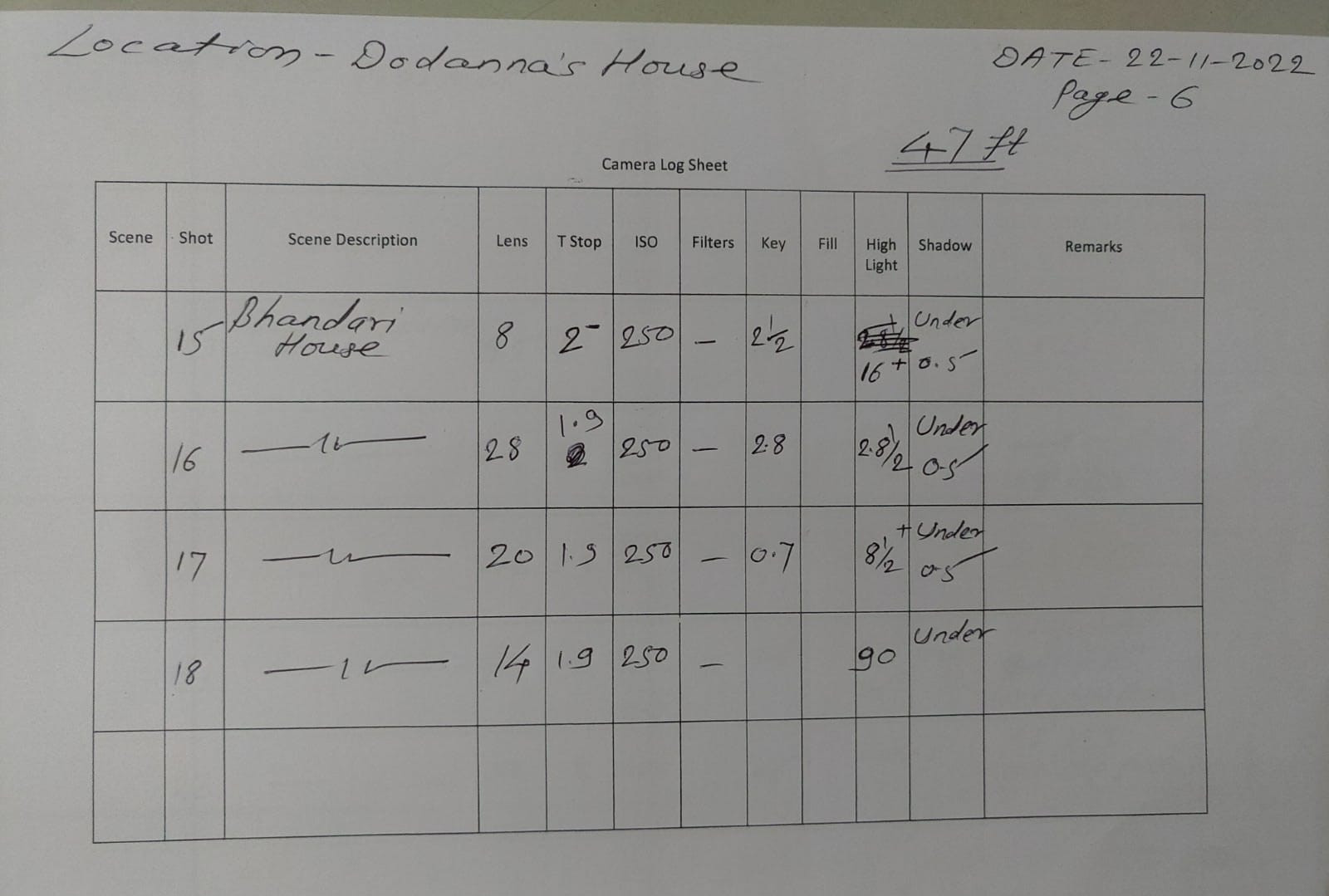
Vikas describes his creative process as trained and intuitive, not formally documented. "There is very little formal documentation of my process as I don't believe in referencing previous works or paintings or anything really," he says. "You just have to be willing to absorb from your life and get a sense of your director and build a language unique for that film."
What was documented, and done meticulously was: camera logs maintained daily by Vipin and the intern; light readings recorded for every set-up; detailed can labels; Anil Ji's register of every can loaded, exposed, sealed, and signed off; and QC reports from Film Lab, which Vikas cross-referenced with Prasad Chennai. Many exposure decisions, though, were made on set in response to the specific conditions of the location rather than from pre-planned specifications. Preparation set the framework, but the real decisions happened on location.
Color Grade Philosophy
Vikas describes his grading approach as fundamentally subtractive – working to preserve and recover the image as shot, rather than adding to it.
"I like to work with the image as close to as it was shot originally, and the grading process is mostly subtractive for me instead of adding things to it," he says. "By subtractive, I mean images which are minimal in their visual manipulation in post – as much of the image is developed on shoot, working closely with the production design team and our lighting choices. This is why my grades take a much shorter time."
He draws the additive/subtractive distinction as a broader position on where an image is actually made.
"Technically speaking, any colorist will be most happy when you give them the flattest image, because they get to do all the contrast, saturation, and layering themselves. But that's not the idea," he says. "Additive color grading is about adding textures over an inherently flat image. Subtractive is about recovering and preserving what is already there."
The grade was completed at Prasad Labs, Mumbai, with senior colorist Kiran Kumar Kota – a frequent collaborator of Vikas' who has extensive experience with celluloid-originated material, and someone who also helped shape the workflow back in pre-production.

On LUTs: Vikas notes his approach to working with LUTs. Unlike Cactus Pears (2025), where a LUT was created for the reference to be used during production, on-set adaptation with a standard LUT (Rec 709) took precedence. However, in Tiger's Pond, there was no scope for any LUT as the image was not even formed during shooting, and they could only access the monitoring of the image.
For Vikas, film and digital aren't different points on the same scale but different paradigms entirely – "it is like comparing oil color and watercolor" – and he sees a straight line from digital's cleanness to filmmakers manufacturing texture after the fact in the grade, and from there to AI-generated imagery.
"We filmmaking people have made AI happen, because we have not practiced with some kind of discipline," he says. "All AI imagery is just simulating the advertising digital imagery we have produced... it is doing it better than what humans can do but it’s so plastic because we made digital images plastic."
“It’s the ecosystem that’s tailored towards selling and buying , which makes new technology happen. But if we want to move away from the corporatisation and trade of it, to arrive at an art form or an aesthetic, then we are battling a lot of battles.”
Notes for Future Preservationists
Asked directly about what he'd want a future restoration technician to know about Tiger's Pond, Vikas was specific:
"I would ask them to not jazz it up. Not try to apply another film's look on this. And not try to compensate for the density differences in the film – it's intentional."
The variation in grain density across the film is a creative choice and shouldn't be normalized away. Scenes with deliberately muddy, open blacks are intentional, not flaws to correct toward a cleaner look. Forest scenes were shot on 200T specifically for deeper, cleaner shadows, and that contrast with the rest of the film is by design. Some shots are slightly out of focus by circumstance, but the ones that survived the cut were chosen deliberately and should be treated as retained creative decisions.
The three fully restored light-leak shots need no further intervention; the two partially restored ones carry a color correction that any future grading pass should be careful not to undo. The film was scanned at 4K 16-bit, and any future down-scaling should work from that master rather than an intermediate export. Processing was consistent across all 60 cans – there are no batch inconsistencies to account for. The negative is currently believed to be held at Prasad Labs, Chennai, with a handful of unexposed cans possibly still at Film Lab's former vault, though both locations need to be reconfirmed.

Underlying all of this is a philosophy Vikas holds about the origin of preservation:
"Preservation begins on set. All the decisions I made – stock choice, exposure, the labeling system, the dispatch rhythm, the fog testing – all of this is a step in preservation. The archive is not a place you send a film to. It is the practice of making the film in a way that the film can be understood later."
Vikas insists on more conversations like this one – the interview itself, or the informal chats with peers and colleagues that often turn out to be an important, if unplanned, step in documenting and passing on knowledge.
– Janhavi


Comments