Simulating War: The State of American Intervention Satire in 2026

Updated: Sep 2
Trigger warning: this piece contains combat and torture detail.
Alia Shawkat was barely 10 years old when she starred as the daughter of an Iraqi ally to a band of American soldiers-turned-treasure hunters in David O’Russell’s 1999 Gulf war film Three Kings. The young actress would go on to play a lead role in acclaimed comedy series Arrested Development before taking dramatic turns under indie filmmakers such as Kelly Reichardt, Jeremy Saulnier and Sophie Hyde. Always keeping one foot in, one foot out of the comedy realm and an open ear for new voices in cinema, she has cultivated an eclectic filmography on par with the bold post-Hogwarts career of fellow former child actor Daniel Radcliffe.
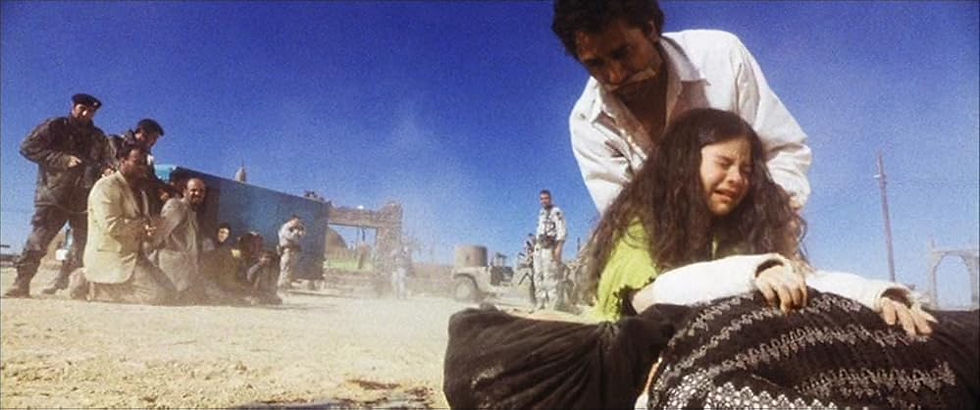
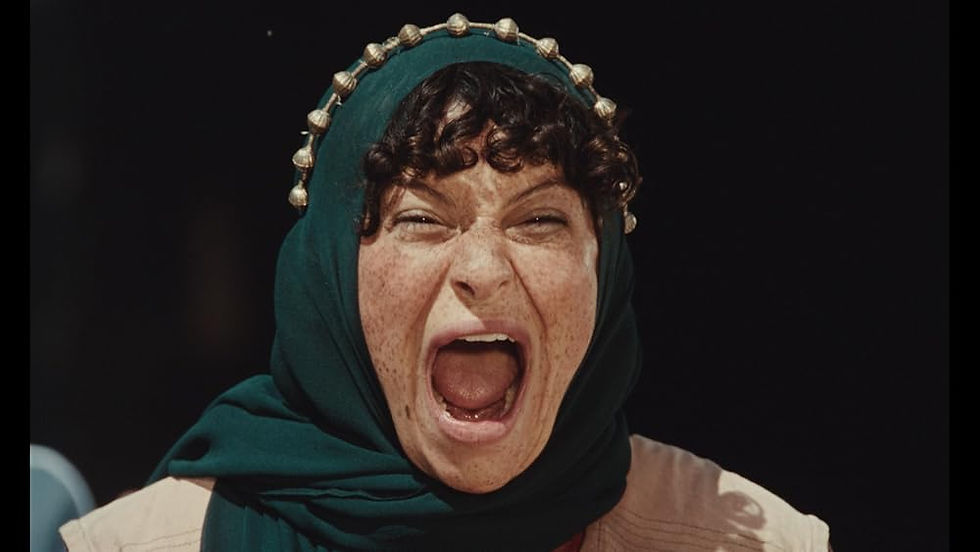
In 2025, Shawkat’s debut role found its full-circle moment. Haley Benton Gates, a first-time director with a background in experimental theater, premiered her film Atropia at Sundance Film Festival. In it, Shawkat plays an actress of Iraqi descent who performs various roles in a war simulation training at a remote facility in the Mojave Desert. Though the film threatens to lose its edge by focusing on a romance between Shawkat’s character and a battle-tested veteran played by Callum Turner (perhaps a deliberate ruse to show how easily audiences can be distracted by adrenaline-fueled love stories), the message of the film sticks the landing.
Gates intimates that, while it’s a step in the right direction that the US is expending defense resources to better prepare its troops for civilian-level interactions, the bloated bureaucracy of the American military complex ensures that the lowest rung of enlistees are unlikely to receive comprehensive explanations as to why they’re stationed abroad in the first place.
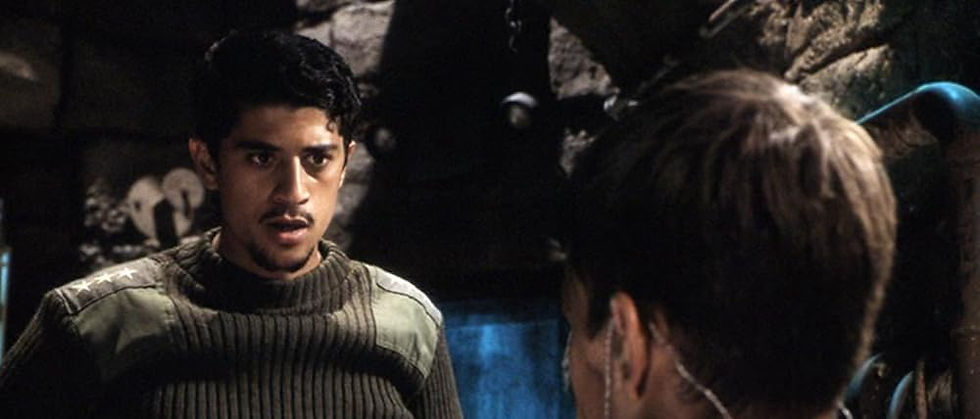
Filmmaker O’Russell dared to file that same charge back in 1999, a critical moment in US history, just a few years shy of the creation of the Department of Homeland Security. In an intense scene that likely would not have passed the extra-sensitive sensors of American studios in a post-9/11 world, Troy (Mark Wahlberg) is tortured by Iraqi Captain Said (Said Taghmaoui). Amidst the interrogation, Said asks Troy why he thinks he’s been deployed there. Troy says they have a duty to protect Kuwait against foreign invasion, and that the US has been enlisted to bring stability to the region. After Said goes on a tirade about how Michael Jackson made himself white because of the inherent racism of Troy’s “sick f*cking country”, he says there is only one reason why Troy has been sent there. He then forces Troy to drink a dose of that “one reason” – oil.
In a book about the greatest movies released in 1999, writer Brian Raftery characterized Three Kings as more bloodshed-conscious than some earlier war films. Despite its individualized depictions of brutality, he contends that “Russell had made Three Kings out of his hatred for violence and his fascination with a war that he could never quite understand." Raftery also recounts an anecdote in which O’Russell met the then-Senator George Bush. As Bush campaigned in the run-up to the 2000 presidential election, O’Russell told him that he was “editing a movie that’s going to question your father [George H. W. Bush]’s legacy in Iraq.” Bush reportedly responded, “I guess I’m going to have to go back there and finish the job.”
Though the shoot of a Three Kings is remembered as tumultuous by those subjected to O’Russell’s vivid on-set personality (among numerous controversies that have stained his career), Raftery's research reveals that the crew of the film reconstructed a village in Arizona and deliberately recruited Iraqi refugees to play extras. For his apparent sympathy to the plight of civilians amid the war, a Los Angeles Arab American group even gave O’Russell a statue (which he promptly shattered). The Clinton administration screened the final cut at the White House shortly before the second Bush took office. By 2003, the president proved that he kept his word: Operation Iraqi Freedom had been launched in full force, and men were back in a conflict that O’Russell had probed in its infancy.
Regardless of whether or not you identify a war hawk, it’s indisputable that propaganda – official or unofficial – is an essential component of keeping patriotism alive. It’s come in many forms over the years, and since the advent of motion picture technology, telling stories on screen has become a time-honored approach to winning hearts and minds. I could sit here all day, typing away about bold, underseen documentaries that debunk American imperialist mythology. However, most media-savvy people are already aware of how popular imagery can be used to prop up a state, often at the expense of another.

My domain of American consciousness – an internationalized and highly skeptical realm – probably sits at odds with the average media consumer and voter that brought our current, warrior-hearted administration into power. In my university days in rural Ohio, there were the movies that played at the on-campus arthouse theater, and the ones that played at the multiplex by the Texas Roadhouse. If not for studying showtimes, I would not have known that some of the movies showing in the big halls existed; they certainly weren’t going to be marketed through my highly personalized social media algorithm, in which businesses pay good money to collect my data and reinforce my dissent.
It didn’t use to be like this. I recently found myself unraveling the curation of my media sphere, comparing the “collective delusion” of the television of yesteryear with the “individualized delusions” of the social media era. Certainly, whatever social circles you grow up in are still likely to shape your initial point of view. Back in the day, though, there were far fewer platforms from which to glean a perspective. The news was the news, and movies could only be watched in theaters. It’s in the same way India developed its cult of Bollywood: Doordarshan was the only thing on TV.
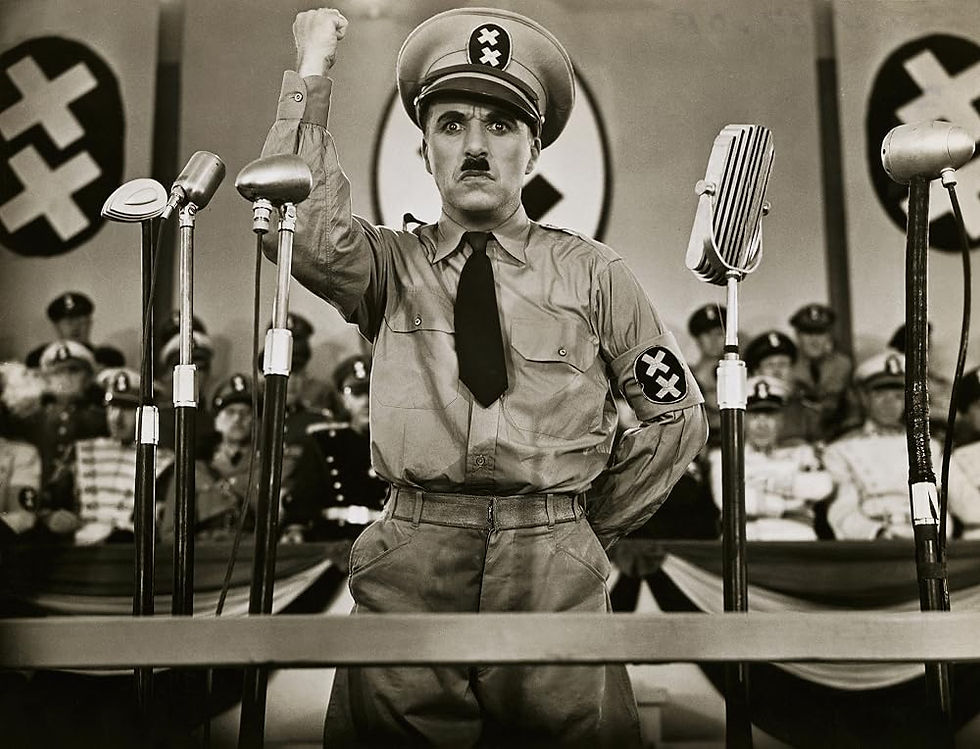
To fully capture the picture, it’s best to return to World War II – the true beginning of American hegemony – and the era with which history buffs first become obsessed. Charlie Chaplin thoroughly denounced global fascism with The Great Dictator (1940), and from then on, it was pretty easy to make the US look like the good guys. Beloved anti-HUAC filmmaker Billy Wilder was an early commenter on the motivations behind the post-war American presence in Europe with his comedy One, Two, Three (1961), but amid McCarthyistic fervor, few others could challenge the national paranoia without risk of being blacklisted.
For some time, the nuclear threat overshadowed the clowns. It is truly a wonder that Columbia Pictures released Stanley Kubrick’s Dr. Strangelove (1964) so soon after the Cuban Missile Crisis, and eight months in advance of Sidney Lumet's identically-plotlined, much more serious Fail Safe. The film ridicules Cold War-era tensions in its depiction of mad scientists and trigger-happy generals who pre-meditate a man-made end of the world.
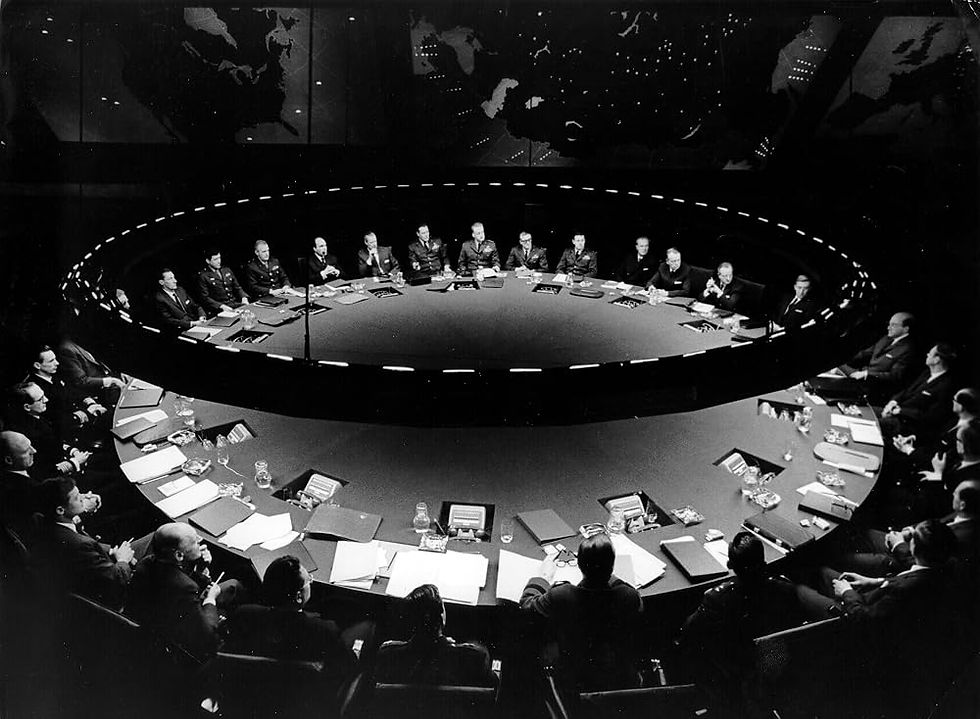
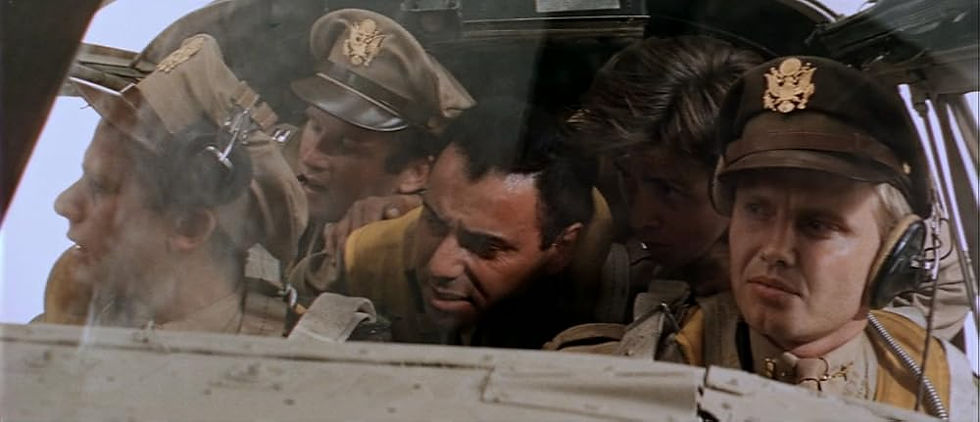
Dr. Strangelove is widely regarded as the definitive satire of the era, though I would also raise Mike Nichols’ Catch-22 (1970) for that title. The film, adapted from Joseph Heller’s 1961 book by Nichols and multi-hyphenate talent Buck Henry, takes place at an American airforce base in Italy during WWII. If you haven’t read the novel, watched the movie or binged the 2019 miniseries, let me summarize it for you: War has been corporatized and human lives are therefore expendable in the name of profit (exemplified by the following line, delivered shortly after the Americans bomb their own base).
“A contract is a contract. This is what we’re fighting for."
Alan Arkin’s character tries to plead insanity to evade performing his soldierly duty, but the catch is that because he can identify himself as being crazy, he isn’t. Bravery and insanity get conflated all the time, and the army certainly doesn’t award a medal for cowardice. This criticism isn’t even exclusive to the American state, but the book is still listed on the American Library Association’s list of challenged books due to a ban exercised by a town in Ohio from 1972-1976, and more recently in Alaska. The official line of reasoning accorded to the ban is the book's profane language and depictions of violence, but the level of ridicule imposed upon army procedure undoubtedly still ruffles feathers all these years later.
Over time, Hollywood opened up to spoofs of the Korean War (1950-1953) such as M.A.S.H. (1970), whose long-running TV adaptation arguably expanded the legacy of the “forgotten war” in popular culture. By the time men were being conscripted for the Vietnam War (1965-1973), there was a more robust, press-documented counterculture, partially thanks to advances in technology. However, there are fewer cinematic satires of Vietnam than there are dramas directly proclaiming the lack of virtue in fighting there.
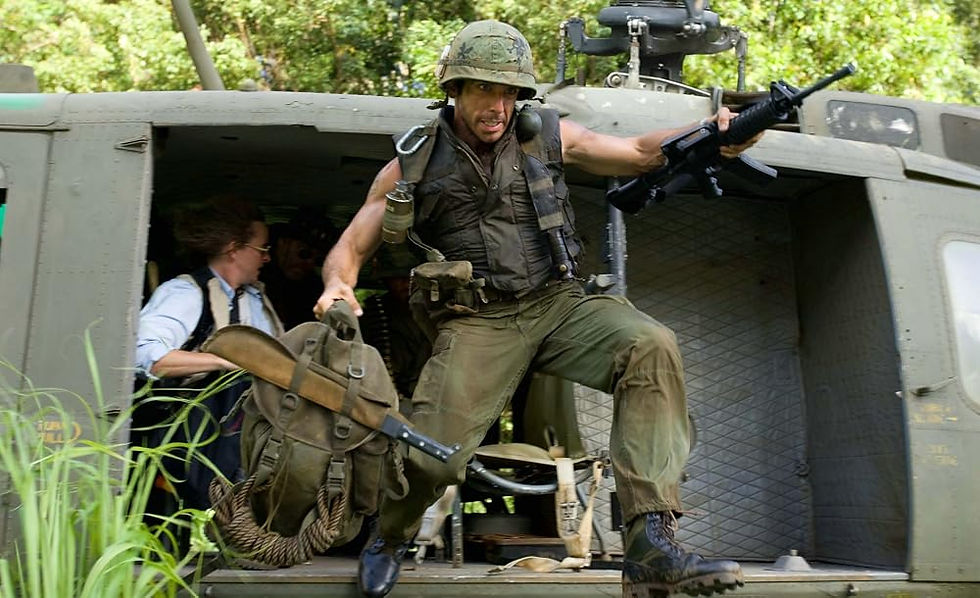
Tropic Thunder (2008) could be seen as the 21st-century answer to films like Apocalypse Now (1979) and Full Metal Jacket (1987) – movies which, while undeniably brilliant, still launched American stars while recreating Southeast Asian misery; Oliver Stone won two Best Director Oscars within three years for war-critical films Platoon (1986) and Born on the Fourth of July (1989). However, it’s important to distinguish that Tropic Thunder is primarily mocking Hollywood, and not necessarily the military as an institution. Andrew Fleming’s Dick (1999) – a personal favorite – satirizes Richard Nixon during Watergate, but not necessarily his actions in the war.
Alongside classic WWII battle retellings like 1998’s Saving Private Ryan and The Thin Red Line, the 1980s and ‘90s saw some punchier movies about international servicemen. Ivan Reitman’s Stripes (1981), featuring Bill Murray as a deadbeat-turned-solider, doesn’t make much of a political statement, except perhaps that charismatic men are likely to fail upward if they join the armed forces. From the creators of Airplane! (1980) came Top Gun parody Hot Shots! (1991), whose slapstick silliness culminates in an early joke about the bombing of Saddam Hussain. James Cameron comedy True Lies (1994), starring Arnold Schwarzenegger and Jamie Lee Curtis, depicts an American agent uncovering an Islamist nuclear terrorist plot. Matthew Alford, author of “Reel Power: Hollywood Cinema and American Supremacy" writes that True Lies' resolution “exalts US violence”.
Slightly less bombastic is Barry Levinson’s Wag the Dog (1997), which tells the story of a Hollywood producer assisting the US executive branch in diverting attention away from a sex scandal by manufacturing a fake war in Albania. This film eerily foreshadowed the Clinton administration’s face-saving tactic after news of the Lewinsky affair leaked: bombing Iraq. Stranger than fiction, indeed.

Then came the aforementioned Three Kings (1999), which was released eight years after the conclusion of the Gulf War, and during the war in Yugoslavia, a devolution of Arab-Israeli ties, and surely dozens of other international undercurrents from geopolitical pies the US had their fingers in.
9/11, as I alluded to, changed things. According to Alford, the sequel to True Lies was cancelled in the aftermath of the tragedy. Ridley Scott’s patriotic and Pentagon-assisted Black Hawk Down (2001), about a 1993 intervention on behalf of the UN in the Somali civil war, was released to an alert American public. It received four Academy Award nominations, despite US-based Somali groups calling for its boycott, and no doubt generated contemporaneous topical questions: if the US is willing to protect non-US political interests for the broader cause of world peace, then what would they be willing to do in the wake of a coordinated attack on their soil?
For the satirist trying to understand the moment, how could one approach spoofing a national narrative-disrupting trauma without disrespecting those who lost their lives? Admittedly, Chris Morris’ Four Lions (2010) does, but it is a British film, with a sense of humor so black that I often hesitate before recommending it. The “Middle Eastern terrorist” threat now inspired the same fear once reserved for the Germans or the Russians.

By the time President Bush set the Afghanistan and Iraq wars into motion – a Gallup poll collected in March 2003 recorded 72% approval rating for the latter – there was an array of media interpretations. In the same year that documentarian Michael Moore derided President Bush in his Palme d’Or-winning Fahrenheit 9/11 (2004), South Park creators Trey Parker and Matt Stone parodied anti-war celebrities like Moore via puppetry in Team America: World Police.
A few years later, psychological thriller bigwig Brian de Palma released Redacted (2007), a harrowing fake documentary about the rape of an Iraqi teenager by an American soldier. Executive produced by billionaire Mark Cuban, the film is easily one of the most negative depictions of US soldiers stationed abroad to come out during the war. However, it performed rather poorly – exaggerated performances aside, almost certainly due to the confrontational nature of the subject matter – and has mostly disappeared from conversations about the war. De Palma's cinematic output has also notably declined since the film's release.
With the US being a high-diversity, low-context culture, its comedic traditions have not typically been grounded in subtlety. That said, of the films I researched, and despite its bombastic, foul-mouthed script, Three Kings had the most nuanced take on the American presence abroad. Harking back to its tenuous identity as a comedy, Alford concurs:
“Three Kings is an unusual ideological product in Hollywood terms, which begins to break down the official history of the Gulf War. Nevertheless, the film presents the US military as the victim of the government’s implementation of inconclusive policies in Iraq, notably the early termination of military force.”
Co-star George Clooney, who has gained just as much of a reputation as an activist as an actor, followed up his role in the 1999 film with other films about the US presence abroad, including Stephen Gaghan’s economically-inclined Syriana (2005) and Grant Heslov’s Iraq war-sci-fi hybrid The Men Who Stare at Goats (2009), in which the oil industry is fodder for conversation. These films stand in contrast to Mike Nichols’ Charlie Wilson’s War (2007), about the US presence in Afghanistan in the 1980s, which Alford discloses was “quietly rewritten to suit the interests of the national security apparatus.” The film was unfortunately the last helmed by Nichols, who had so successfully adapted Catch-22 nearly 40 years prior.
I turn now to Clint Eastwood.

The man has made a lot of movies, including some where he portrayed WWI and WWII soldiers, like in the comedy Kelly’s Heroes (1970). In Heartbreak Ridge (1986), he played a Korean War veteran tasked with leading the controversial invasion of Grenada.*
*The many stories of US involvement in Latin America remain an investigation for another day, but one could always start with Walker (1987).
Later in his career, Eastwood reflected on the soldier and veteran experience in a way that tended to show respect to both sides of the conflict, as recorded by critics praising Flags of Our Fathers (2006) and Letters from Iwo Jima (2006). He also scored a movie that concurrently reflected the Iraq conflict in 2007’s Grace is Gone. I would argue that American film awards stopped rewarding foreign intervention stories around the time that the backlash about the true story of American Sniper (2014) came to fodder.

To qualify this statement, it was in 2009 that Kathryn Bigelow’s The Hurt Locker, about a team of American bomb defusers in Iraq, won Best Picture and Best Director. This win was seen as progressive, as she was the first woman to receive the honor. Initially, she received similar acclaim for 2012’s Zero Dark Thirty, about the assassination of al-Qaeda Osama bin Laden, but the film was subsequently criticized for its information sourcing, representation of Pakistanis and portrayal of torture.
Ben Affleck’s Argo, a less violent take on the ra-ra diplomacy genre depicting a hostage rescue mission after the 1979 Iranian revolution, won Best Picture in 2013. By then, the Arab Spring had taken shape overseas, and whether Americans cared deeply about it or not, its effects rippled into the Afghanistan question, a decade-long inherited war that the Obama administration was now fighting. The Academy Awards could serve as a temperature check on how patriotic the arts community was feeling.
Eastwood's American Sniper made over half a billion dollars worldwide and received six nominations at the 2015 awards, but was soon met with a wave of scrutiny. Even though the film attempted to explore the impact that combat left on Chris Kyle’s post-war psyche, claims of story fabrication prevailed. A further concern was raised over whether it was the right occasion to commemorate a man who killed over 160 people in a divisive war whose broader scope left over 200,000 civilians dead. Eastwood walked away from the Oscars empty-handed. The representation of the troubled veteran was no longer meshing with the war-weary political climate.
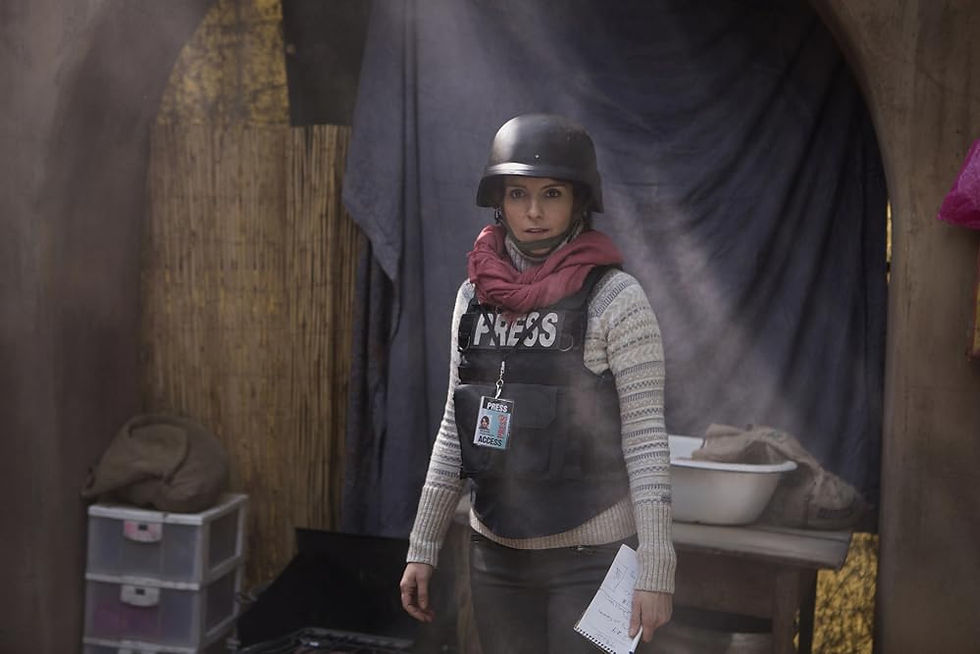
Toward the later 2010s, studios seemed to perceive true-to-life war stories about involvement in the Middle East as more of a risk. Whiskey Tango Foxtrot (2016) covered the early days of American intervention in Kabul from the perspective of a female journalist often assisted by her US military protectors, offering the conclusion that risk was a drug for reporter and soldier alike. There were 13 Hours (2016) and 12 Strong (2018), which recount operations in Libya and Afghanistan respectively, but by the late 2010s, public approval of the wars was slipping. An AP-NORC poll conducted in August 2021 amid the final weeks of US withdrawal from Afghanistan recorded public approval for the war there at 35%. Retroactive approval about the Iraq War had dropped to 34%. The cinematic genre had simultaneously lost its groove.
Rod Lurie’s adaptation of CNN correspondent Jake Tapper’s Afghanistan-set book, The Outpost (2019), which stars Clint Eastwood's son Scott and received mixed-to-good reviews, flew under the radar. Michael Bay went back to making Transformers movies, and Clint made six more movies with only two Academy nominations between them: Best Sound Editing for Sully (2016) and Best Supporting Actress for Richard Jewell (2019). The pandemic certainly didn’t help; even once theaters were booming again, Gerard Butler-vessel Kandahar (2023) made only $5 million domestically on an 8-figure budget, compared to 12 Strong, which had managed to bring back its bank, and then some.
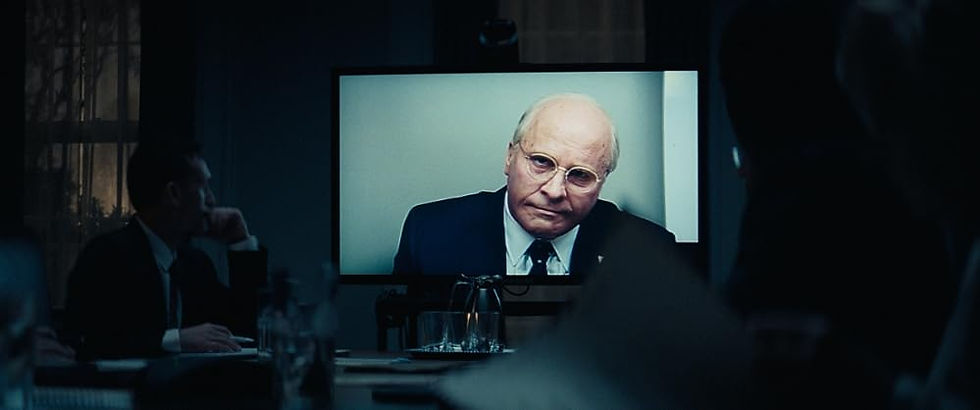
In parallel, Adam McKay was shedding his reputation as a Will Ferrell comedy machine and moving toward more aggressive dissections of American politics. His 2015 docu-comedy The Big Short, about the 2008 housing bubble bust, was well-received, and he used that momentum to then produce Vice (2018), a caustic portrait of Dick Cheney in the years leading up to US involvement in the Iraq war.
The film received eight Oscar nominations, but is generally regarded as unsubtle and has gained a reputation as one of the weaker films ever nominated for Best Picture. McKay subsequently shifted his gaze to the climate crisis with the star-studded and demoniac apocalypse movie Don’t Look Up (2021), which also received a few nominations from the Academy despite its polarizing, pandemic-era ethos. Given this – as much as it pains me to say it – McKay is probably the leading anti-establishment satirist working with major studios today.
Enter – or, perhaps re-emerge – Alex Garland. The London-born filmmaker worked on a number of high-concept sci-fi films over the years, including the A24-distributed Ex Machina (2014), whose success helped him and the studio become household names. Branded as one of Hollywood’s leading intellectuals who could also work with scale, he was in a good position to take advantage of the political climate leading up to the 2024 election, which he did by hypothesizing Civil War.*
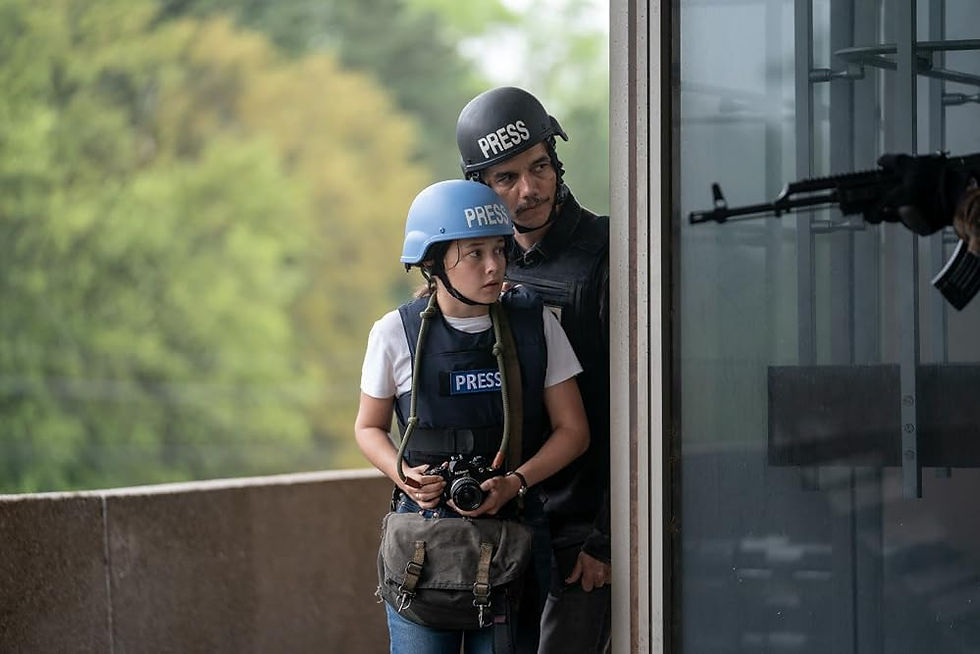
*I appreciate this movie more than most because of how it warps the purported “objective” lens of war journalists. Three Kings, notably, also features two reporter characters with clashing ethical outlooks. Plus, we seldom see such a conflict theorized in the US without an alien invasion angle – note how the “alien” acts as a metaphor.
Soon after the Englishman’s discourse-generating probe into the domestic state of the union, he unveiled a true-to-life story about Americans in Iraq: Warfare (2025). Garland’s casting capitalized on celebrities of the social media era by plucking beloved actors from young adult series, hopefully (executives crossed their fingers) to inspire a hubbub of dialogue among Gen Z-ers who neither lived through 9/11 nor considered how it changed the trajectory of their lives. Slap an A24 label on there, and he was sure to find a new constituency.
As one of those Gen Z-ers, I couldn't deny that it was a shrewd marketing choice. I was prepared to receive the movie with open arms, but Warfare essentially recounts the play-by-play combat experience of its co-director, Ray Mendoza, without much reflection on the circumstances that brought him to that life-altering moment with his platoon. The film concludes with footage showing the film’s stars training with the former SEALs, thereby unraveling any emotional build-up with the reminder that it was manufactured to commiserate and get our adrenaline pumping.
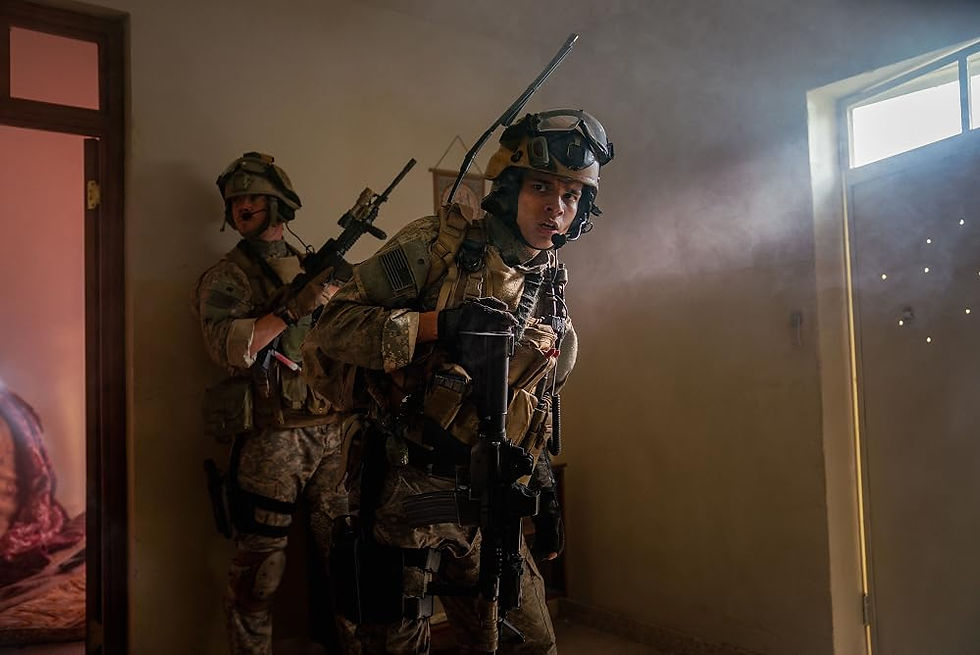
Mendoza says the shoot was therapeutic, though I would clamor for other testimonies about feelings experienced among veterans who watched the recreation of an IED explosion that left multiple men with intestines leaking out of their bodies. Viscerality aside, I had to ask myself, why are we telling this story with so little context?
Which brings me back to Atropia — a film about simulating war. It takes place a few decades back, partially because writer-director Gates was reportedly denied access to recording military exercises for a documentary, leading her to instead shoot the short film Shako Mako (2019), also featuring Shawkat. The actress called her return to playing an Iraqi civilian in Atropia a “beautiful, or kind of sick irony”. Will there be a resurgence of filmmakers other than McKay aspiring to illustrate that irony, or will it remain a cult idea among the independent film crowd?
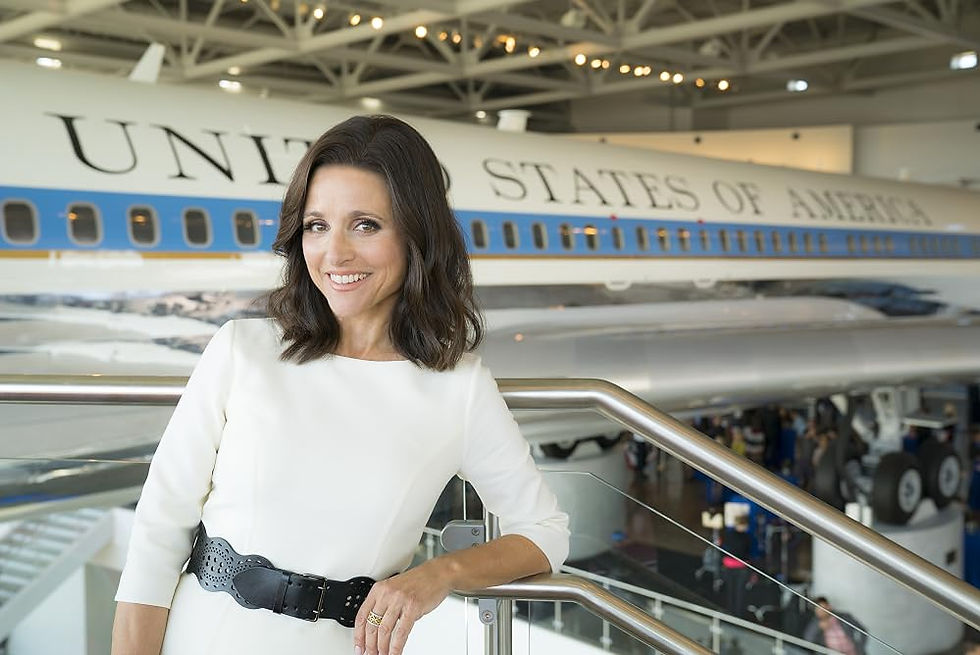
Once upon a time there was The West Wing (1999-2006), whose White House leadership was depicted as intelligent and morally complex. A few years down the line, Netflix treatment House of Cards (2013-2018) gave the ivory tower a dark spin. Concurrently, Armando Iannucci’s Veep (2012-2019) scathingly satirized the Oval Office in sitcom formula until the conclusion of the first Trump administration, with the series finale forecasting a bleak future. Life in America goes on – but has real-time access to information about war made us too self-aware? Will the US ever rally around a cause so committedly as the country mythologizes itself to have done during WWII? Or will the conflict just endure, passing unchallenged until the next leadership curates the narrative that most align with its priorities?
In February, President Trump started a war without congressional approval. Under the 1973 War Powers Act – created as a check on executive power during the war in Vietnam – such a war must be terminated within 60 days. Despite the timeline lapse and both houses passing a resolution calling for a withdrawal of forces, airstrikes have continued. Attacks on Iran have rippled into other states, including Iraq, recalling previous interventions in unstable states under the guise of good governance — with the practical sub-agenda of natural resource control. Critics have labeled the intervention as a red herring against the Epstein files – a repeat of Wag the Dog’s pessimistic premonition. In June, Gallup recorded a measly 34% approval rate of the present intervention among registered voters.
A few months ago, it was announced that Michael Bay would direct a film for Universal Pictures depicting a military rescue mission in the Zagros Mountains that took place in April. The book that the story is being adapted from won’t be released until 2027, but pre-production for the movie has already begun. The filmmaker has had a long relationship with the Department of War in order to bulk up his blockbusters, but that familiarity did not stop him from recounting a moment of pride while filming a Super Bowl commercial for the Secret Service.
The action war movie has certainly got a move on its side of the narrative. Perhaps that means the space has opened up for a Three Kings-style takedown of what’s been happening in the Strait of Hormuz. Telling others’ stories often requires research, and there is no better way of doing that than building strong partnerships with the institutions that the artist is representing. But it’s a fine line; if the government begins to intervene in the depiction of its laymen for the sake of the national interest, then the art may be co-opted. Some writers joke that the state of affairs is just too bleak these days, and nothing they dream up could be more satirical than what’s actually happening. Real life is as entertaining as TV, and isn’t that exactly what the Trump administration wanted?
-Lydia

Comments