'Send Help': Tropical Terror, Corporate Comedy

If there is any throughline to Sam Raimi’s expansive, adventurous filmography, it is his striving to be Hollywood’s greatest and most unpretentious prankster. From his early work in the 1980s to his contemporary studio projects, Raimi has demonstrated a clear and deliberate creative practice, synthesizing formative influences as varied as The Three Stooges, superhero comic books and the atmospheric genre films of Jacques Tourneur into a set of identifiably offbeat filmmaking idiosyncrasies. These influences are most overtly visible in the anarchic, hack-and-slash sensibilities of The Evil Dead trilogy, yet they persist — albeit in cleaner and more sentimental forms — in larger-scale studio productions such as the Spider-Man trilogy or The Quick and the Dead. They are also manifest in his latest film, Send Help.

When career-focused corporate strategist Linda Liddle (Rachel McAdams) is overlooked for a long-promised promotion by her bull-headed new CEO, Bradley Preston (Dylan O’Brien), the two become locked in a psychological battle of wills and primal survival instinct after a business trip goes awry, leaving them as the sole survivors on a deserted island.
In my film journey, Raimi stands as a definitive figure. His work shaped my understanding of what movie-making is, and how the medium can function as both spectacle and play. Consequently, when Raimi announced a return to his slapstick sensibilities via a warped fusion of Cast Away and mid-century serial storytelling, I found myself predisposed to view the project as one of my most anticipated for this year. I am happy to say, in spite of its foreboding January release date, that Raimi has delivered.
Raimi has spent the past sixteen years on a stretch of largely work-for-hire projects. Send Help serves as a clear indication that the genre-loving goofball gaffer has not only retained his instincts, but refined them. The film finds Raimi applying his signature tongue-in-cheek sensibilities to an entirely new cinematic playground, one that allows him to deploy more than four decades of hyper-kinetic camera choreography with renewed precision and confidence. Sun-scorched beaches, dense tropical jungles and eroding rocky cliff faces become dynamic staging grounds rather than passive backdrops, each carefully exploited for both visual humour and escalating tension.
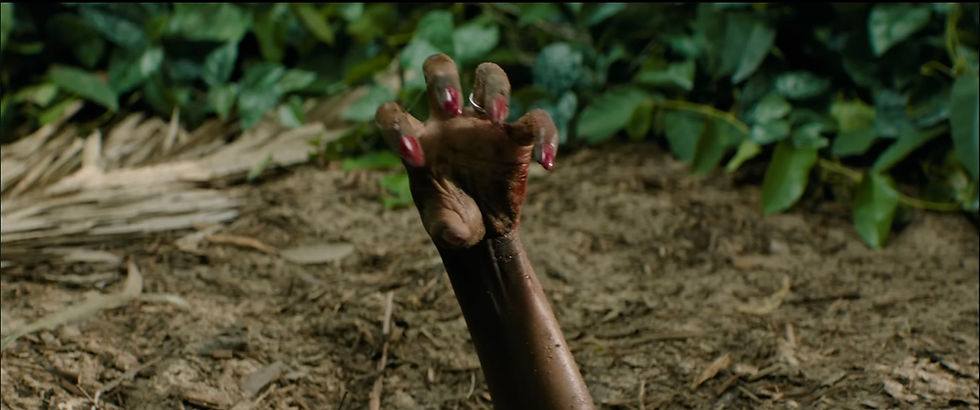
These environments are further animated through an imaginative array of set-piece obstacles that force the film’s 9-to-5 corporate protagonists to react, adapt, and regress into primal modes of survival, bloodthirsty wild boars, punishing tropical storms, and grotesquely oversized, juice-squirting insects chief among them. Raimi’s direction ensures that these elements function not merely as shocking visuals but as extensions of character psychology and thematic pressure. Moreover, the film’s use of 3D is not treated as a novelty, but as a compositional tool that heightens physical immediacy and spatial awareness, allowing the imagery to revel unabashedly in its own excess while reinforcing Raimi’s long-standing commitment to experiential, audience-facing cinema.
Even beyond the film’s indulgence in excessive goop, muck, and bodily ooze, much of its effectiveness hinges on the extraordinary performances delivered by McAdams and O’Brien. Both actors fully commit to the cartoonish extremity inherent in the film’s employer-employee power imbalance, skillfully translating familiar corporate hierarchies into a heightened framework of do-or-die survival tactics. Their performances operate at the intersection of physical comedy and psychological deterioration, allowing character dynamics to evolve organically as authority, competence and control are repeatedly destabilized.

Notably, the film demands its typical Raimi degree of physical and emotional exposure from its performers, with extended passages devoted to screaming, wincing and full-blown loss-of-control breakdowns — elements that are embraced rather than restrained. These moments are not merely gratuitous but central to the film’s tonal architecture, reinforcing its thematic interests in humiliation, regression and dominance. Though it remains early in the year, O’Brien’s turn in particular stands out as a strong contender for the funniest — and most exquisitely pathetic — performance of the year.
What a complete, joyous and justifiably feral return to form from one of cinema’s greatest slapstick kings. Watching Send Help feels like reconnecting with an old friend who has been away for far too long — someone whose mischievous spirit and inventive energy reminds me why I first fell in love with filmmaking in the first place. Raimi’s ability to balance outrageous physical comedy, razor-sharp editing, and genuine human stakes is as fresh and exhilarating now as it was decades ago, and it’s impossible not to marvel at his enduring skill and creativity.

I can only hope that Raimi continues to produce back-to-basics, character-driven genre vehicles, rather than being pulled back into the often soulless grind of modern franchise filmmaking (though, one could still dream of a Darkman 2 in his hands). His work reminds us that cinema can be both playful and profound, grotesque and heartwarming, absurd and deeply human, often all at once. Welcome back, Sam. We sickos have missed you.
-Jack


Comments