From the Depths: ‘Panelstory or Birth of a Community'

Updated: Sep 15
The vignette movie serves the same purpose as a composite novel: brief peeks into lived experiences, with all their similitudes and contrasts, often intersecting into a single narrative by the conclusion. Robert Altman’s Nashville (1975) and Short Cuts (1993) serve as classic American examples, but this technique has a home in nearly every film culture: Federico Fellini’s Amarcord (1973), Judo Itami’s Tampopo (1985) and Roy Andersson’s Songs from the Second Floor (2000) are a few such examples.
In the Czech context, filmmaker Miloš Forman gained a bombastic reputation for his observational satire, The Firemen’s Ball (1967), whose double entendres about a party full of incompetent firefighters triggered the Communist censors of the time and ultimately preceded his relocation to the United States. However, many of his contemporaries stayed in the country, including the trailblazing Věra Chytilová, who later followed up her 1966 experimental hit Daisies with a vignette story of her own.
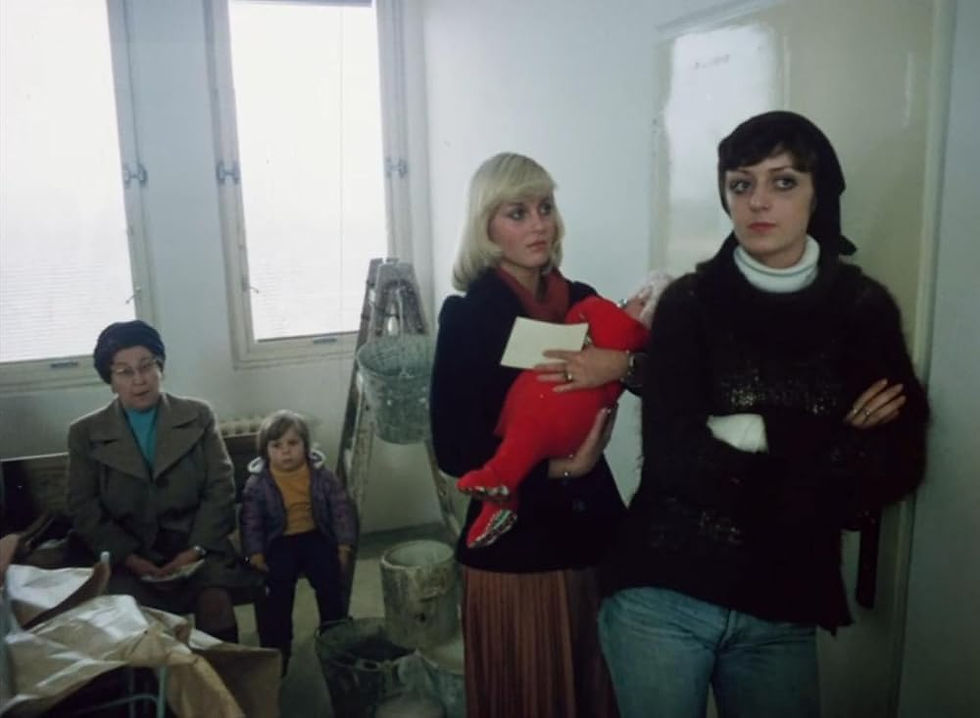
Where The Firemen’s Ball captured the casual hypocrisy of the 1960s Czech Communist elite, Panelstory or Birth of a Community (1979) captures the proletariat attitutudes after the 1968 Warsaw Pact invasion and during normalization, the final years of the Soviet Union’s attempt to centralize its economy before the Velvet Revolution. Chytilová made the film in the late 1970s, but it was withheld from Czech audiences until 1981. It depicts various personalities at a socialized housing project, many of whom are squatters, over the course of a day. Its digital restoration by the Narodni Filmovy Archiv premiered at the Berlin Film Festival earlier this year.
The drabness of concrete and rubbish piles is only offset by the occasional pop of red: a little boy in a red coat, apparently unaccompanied and causing a ruckus everywhere he goes. Chytilová turns a fish-eye lens onto this brutalist playground, covering her human and industrial subjects with Dutch-angled fish eye lenses and discordant music.

Other characters include a niggling old man, a woman with a newly pregnant daughter, a broke actor, and a doctor from Mozambique, the latter of whose featurette is "resolved" with a fascinating montage between a topographical map of Africa and shots of the dirt mounds that have amassed outside the neighborhood’s identical living complexes. Birth and unpersonified machinery are similarly paralleled on other occasions, provoking interesting questions about Chytilova’s much-debated views on the feminization of the workforce.
The script is extremely funny, as most Czech films are, because there is nothing too dark to laugh about. We are graced with many instances of non-diagetic retorts, seemingly based on the editor's whims regarding the most ironic framing for selling the joke, and jump cuts galore. On multiple occasions, the idea of living in “peace” is suggested, only for the next shot to expose a trashcan fire or a screaming housewife or the aforementioned little boy throwing a ball through a window pane.
“You don’t distinguish between things pleasant and unpleasant, but things useful and unuseful,”
says a charismatic actor to a woman he’s trying to seduce, and if that doesn’t capture the spirit of late-socialist era realism, I don’t know what does. Everyone is sort of pretending, but not very well. And it doesn’t really matter. Opportunism is rampant because advantages are mild at best. Inefficiencies ruin even the best-laid plans. The mailwoman just needs to drop off her letters, the insurance guy needs to cover his costs, and the handymen need their tenants to leave them alone.

Chytilová's film conveys an uncanny truth that, regardless of your generation, how well-behaved your children are, or whether your husband abandoned you for the drink, inconveniences of an unfeeling system unite us all. And thus: a community is born.
Panelstory is currently streaming on the Criterion Channel.
-Lydia


Comments