'House of the Dragon' Season 3 Can't Quite Reignite Its Spark

Updated: Aug 13
The following review contains major spoilers for House of the Dragon.
Two years later and House of the Dragon is back with what I’ll call a muted vengeance. It’s no longer the best Game of Thrones spin-off on television, and the season’s trajectory is a bit like a glorious bonfire flame that gets prematurely smothered, but that isn’t to say it’s not worth your time. Hear me out.

I adore House of the Dragon’s first season. It brought back the political intrigue that the later seasons of Thrones had suffered profusely from ditching, and its structure was genuinely riveting. The story took place across roughly 20 years – featuring large time jumps and a major recasting halfway through – as we traced the peaceful reign of King Viserys I Targaryen (Paddy Considine) and the rising tensions between his daughter-cum-heir-apparent, Rhaenyra (Emma D’Arcy, Milly Alcock in early season one), and second wife, Alicent Hightower (Olivia Cooke, Emily Carey before the recast).
Season two wasn’t without merit (most notably Episode 4, which served as a triumphant mid-season surge and remains one of the show’s best episodes), but it was undoubtedly a downgrade. Plotlines became slow and directionless, dialogue wasn’t as gripping from line to line, and the abrupt ending felt incredibly anticlimactic. Coupled with the traditional two-year wait for another season, it killed a ton of fan momentum, which wasn’t helped earlier this year when A Knight of the Seven Kingdoms stormed onto the scene as the newer, shinier Thrones offshoot, helmed by Ira Parker from the season one writers’ room.
But then something wonderful happened: House of the Dragon brought the heat.
The first two episodes of the latest installment are the strongest start of any new season of TV this year. Episode 1 hit the ground running by adapting the Battle of the Gullet – a maximalist bout of combat best described as “dragon-infused naval warfare” – wherein Corlys Velaryon’s (Steve Toussaint) fleet dukes it out with an immense Triarchy armada. It was some truly elite spectacle – a multi-stage skirmish reminiscent of iconic Game of Thrones high points. The death of Rhaeynra’s firstborn son, Jacaerys (Harry Collett), at the end of the episode also set the stage perfectly for what was next.

In Episode 2, Jace’s death acts as the catalyst for a major shift in the balance of power. Rhaeynra expectedly breaks down after losing another son, but this grief soon turns to ruthless determination to reclaim the usurped throne. Daemon (Matt Smith) reunites with her on Dragonstone and they head to King’s Landing, beheading Otto Hightower (Rhys Ifans) – their imprisoned adversary and Alicent’s father – before taking back sovereignty over Westeros. The absolute stinger of Alicent being brought to the throne room after her escape attempt and being met with her father’s body – along with Rhaenyra atop the Iron Throne – was a peak for the season’s emotional stakes. It’s here that the external conflict felt most motivated by character-centered dramatic beats, which, unfortunately, wouldn’t last.
The season doesn’t quite nosedive from here, and Episode 3 is still a solid showcase of Rhaenyra’s struggles as she adapts to power, but the narrative momentum mostly stalls out until the finale as the writers lackadaisically dispense generic, drawn-out fantasy politicking without much trace of nuance. The consolidation of the first season’s cast feels like a distant memory, as everyone is off on their own meandering subplot in some remote part of the realm rather than under a single, unified trajectory. Game of Thrones proved expansive storytelling can succeed, but it’s way too aimless here to feel purposeful.
It’s an issue that plagued last season as well. Season one was so refreshing for how it balanced its vast medieval setting with focused royal friction and kinetic pacing. Now that all of the threads have been separated, the string feels a lot thinner. Part of this can maybe be attributed to showrunner Ryan Condal, whose working relationship with Thrones author George R. R. Martin has greatly soured (Martin reportedly remarked “this is not my story any longer” in a season three development meeting after Condal shared his vision for the series’ future). Everyone and their mother knows how bad the writing became on the original series once David Benioff and D.B Weiss diverged from Martin’s source material.

The inciting incidents and crescendos are still reliably worthwhile television, but it’s that middle portion – the real meat and potatoes – that drags. Aemond (Ewan Mitchell) spends most of the season oen the sit-out bench at Harrenhal, slogging through sad boy incest visions rather than nerfing Rhaenyra’s forces like we know he’s capable of. It’s grossly repetitive of Daemon’s season two storyline and blankets an otherwise powerful character in order to stall for time and stretch out the series.
Aemond’s sidelining, of course, is to make way for Ormund Hightower (James Norton), the Greens’ military heavyweight who becomes the de facto antagonist as the rest of his house is in free fall. The abundance of Ormund screentime in Episode 4 is the first time the season truly loses sight of itself, and while Norton provides him some heft, the character is never quite cunning or maniacal enough to make his mark. Knowing that he won’t be utilized going forward (on account of his incredibly rushed death via dragonfire in the finale), it’s disappointing that we didn’t receive more time with our pre-existing military rogue (Aemond) or schemers like the Littlefinger-coded Larys Strong (Matthew Needham).
Larys, at the very least, has an exceptional dynamic with Aegon II (Tom Glynn-Carney), whom he smuggled out of King’s Landing in the final moments of season two in order to keep his options open. Both disabled and on the run, they form an odd partnership – privilege versus pragmatism – in a subplot that sparks cleverly devised dark humor and reality checks for the deposed king, who gains humility in the face of his royal lifestyle being stripped away.
Aegon emerges the season’s best character, his entitlement crumbling as he’s forced to live as a pauper in a move mirroring Jaime Lannister’s masterful season three Game of Thrones arc. These fortifying lows see invigorating payoffs when Aegon makes a brave final stand against enemy troops in Episode 7 before being saved by his thought-dead dragon, Sunfyre. He subsequently confronts Aemond at Harrenhal in the finale about the attempt on his life, but means to reforge an alliance with his brother in order to take down Rhaenyra instead of seeking petty vengeance, a rather mature note to end on.

Likewise, the technical aspects of the show remain strong as ever. The season cost an estimated $20 million per episode which, in line with previous installments, can afford some of the most impressive production design and visual effects on the small screen. The color correction is more hit-or-miss, with some shots lacking contrast and occasionally appearing undersaturated, but the cinematography is generally very competent. This season saw an increased incorporation of shallow depth-of-field, which some viewers might’ve found distracting, but the blurring of extravagant, majestic locales in favor of hyperactive focus pulls during character close-ups was a bold stylistic juxtaposition that I found engaging. It also helped make dialogue-heavy sequences more hypnotic when the writing alone didn’t quite serve that effect.
I remain baffled by the uneven quality of this season, and wonder how it could fizzle out after all the “hype aura moments” during those first two hours. The root of this seems to be a combination of HBO budget restructuring and the 2023 industry-wide strikes, both of which contributed to the creative team abruptly having to cut down season two from 10 episodes to eight after the scripts had already been mapped out. This led to season two’s aforementioned anticlimax — a glorified setup episode that was never intended to cap off season-long plotlines — and season three beginning with a bang.
Game of Thrones was known for bombastic penultimates with ambitious battle sequences (see: “Blackwater,” “The Watchers on the Wall,” “Battle of the Bastards”) and the Battle of the Gullet feels much more in line with those than the franchise’s premieres. And HOTD’s “Queen’s Landing” is the exact kind of narrative zenith you’d expect to see as a closing chapter, not a sophomore episode. Blame the financial behind-the-scenes drama, but it’s still up to the writers to find a way to retain dynamic pacing amidst unforeseen cutbacks.
The Purple Wedding in early season four of Thrones, for example, works so well because it provides narrative weight by kickstarting Tyrion’s roller-coaster trial storyline. It’s more than just well-conceived shock value to hook viewers before a dull season. Rhaenyra’s ascent, in contrast, effectively shakes up the status quo, but the rest of the arc isn’t propulsive enough so as to not let it down. All of season two’s resolution was tacked onto the beginning of season three, and starting at a high like that risks a frontloaded episode sequence that peaks too early.
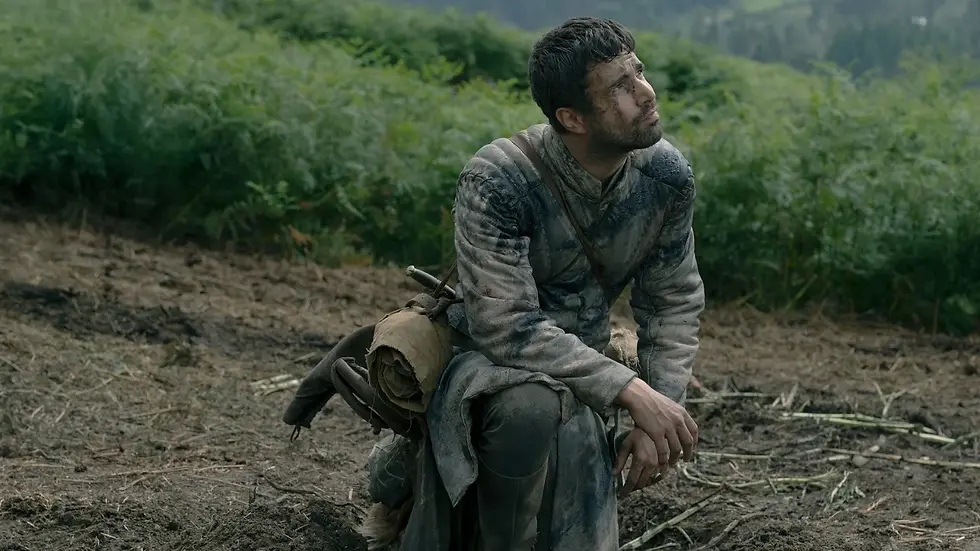
A microcosm for these larger issues is Episode 6 – specifically, the death of Ser Criston Cole (Fabien Frankel). I’d been praying on this man’s downfall for so long that I began to relish his end, and while Cole explicitly not earning a warrior’s death – instead being unceremoniously disposed of by a random archer – is a fitting conclusion that denies him glory, the choice to haphazardly place it at the beginning of the episode is a jarring step too far.
He’s a footnote in a larger story, sure, but he’s also a major character who we’ve been following since early season one. Look no further than Andor’s “Who Are You?” for a successful abrupt major character death, one that’s placed at the end of the episode so as to both honor the moment’s in-universe poetic insignificance and reward long-term audience investment. Cole’s death is overly telegraphed when he explains his ideal demise in a monologue to Ser Gwayne Hightower (Freddie Fox) the previous episode, making it ring hollow, and is then followed by 50 minutes of humdrum military maneuvering. Once again, it’s a structuring error that disserves the otherwise high-quality writing and forces the episode’s most impactful moment into the first act so as to make the rest of the content appear more bland by comparison.
Within the context of the season, Episode 3 functions most similar to a typical premiere based on its character positioning, and I fear Rhaenyra’s main conflict of ruling her people peacefully versus securing her position through armed force isn’t consistently compelling enough to sustain all her A-story screentime. I like having Mysaria (Sonoya Mizuno) and Daemon around as the angel and devil on her shoulder, respectively, alternately pushing her toward noble leadership or the brutality of war, but it manifests more in Rhaenyra lollygagging on her choice rather than engaging in meaningful conflict with either of them.
One thing is for certain: Emma D’Arcy is still absolutely carrying this cast. The devastating effect of Jace’s death on Rhaenyra allows D’Arcy to come alive early in the season with some unrestrained emotion contrary to their typical headstrong nature. It’s a magnificent tightrope walk between a grief-stricken mother’s agony and the necessary composure of a queen. Once settled in King’s Landing, the performance also really nails the exhaustion that comes with the burden of power. I hope they get Emmy recognition next year, as they’re still throwing down some of the best acting on TV right now, and the darker turn for Rhaenyra that the finale is pointing to keeps me hopeful for season four.

I come out of season three primarily disappointed, but only because its initial burst of energy suggested a return to form that ultimately proved short-lived. It’s about on par with season two, and is honestly still much better than a lot of mediocre television, despite committing the cardinal sin of being a little boring. Condal is able to helm some technically well-polished scenes and makes some interesting decisions when he isn’t dropping the ball on the characters’ senses of agency. I still eagerly await the conclusion of the Targaryen civil war; let’s just hope the writers ditch the slow, parliamentary flint and steel method in favor of their initial lighter fluid.
-Ethan


Comments