Doubting 'Fjord': A Voice from the Romanian Diaspora


This September, the 5th annual Romanian Community Summit was held in Chicago (or more accurately, Brookfield – claiming a suburb as part of the city is a classic Chicago gambit). I was there as a volunteer, in a futile attempt to network. It was not quite my professional crowd: the itinerary included such fascinating topics like “How Will AI Agents Rewire Businesses”, “The Real Estate Wealth Blueprint: 5 Ways Real Estate Builds Wealth, and How You Can Get Started”, and other buzzword-laden LinkedInslop.
Unfortunately, my fellow volunteers did not seem interested in networking, probably because they were high schoolers and could not assist me in making professional inroads. I tried to mingle with the attendees and received some invaluable advice: “The Romanian community is very powerful, but you have to leverage the network” (there was no elaboration on this, as if that and a handshake would suffice).
Having to endure the indignities of a networking event was initially fine with me, because at the end of the day, I was promised encouragement from big-time Romanian director Cristian Mungiu. He’d been working overtime to put Romania on the map this year with his newest film, Fjord, a buzzy courtroom/domestic drama in the vein of Anatomy of a Fall (2023) – which, like Fjord, won the Palme d’Or at Cannes. Unfortunately, Mungiu was not physically in attendance, but he left us with a video message that urged us to support his new film ahead of the Oscars campaign.

That this brief video was so preoccupied with the notions of Romanians supporting Romanians and getting him to the awards show was very telling to me, both in that moment and as I watched the film. It is illustrative of how Mungiu presents the central conflict of Fjord, and what he hopes to achieve via that presentation.
Fjord follows the Gheorghiu family, helmed by patriarch Mihai (Sebastian Stan, who has never looked more Romanian in his life) and his Norwegian wife Lisbet (Renate Reinsve, reuniting with Stan after 2024’s A Different Man), after they relocate their five children to Norway. The Gheorghius are evangelical Christians, and their religion and conservativism contrast with the very liberal Norwegian society they find themselves in. Their neighbors are the local school headmaster Mats (Markus Tønseth), his wife Mia (Lisa Carlehed), and their daughter Noora (Henrikke Lund-Olsen), the latter of whom grows close to the Gheorghiu’s eldest daughter Elia (Vanessa Ceban).
One day in gym class, a teacher at school (who also works with Norway’s Child Welfare Services) notices bruises on Elia’s body and reports the Gheorghiu family on the suspicion of child abuse. From there, the children are separated and put into foster homes as the parents await civil trial. This is the central conflict of the movie.
What follows is framed in an extremely disingenuous way. This is not a movie about child abuse – we barely get the perspective of the Gheorghiu children. Instead, the film is more occupied with the culture war surrounding the perceived religious persecution of the Gheorghius. In the film's trailer, we hear Mihai ask the prosecuting attorney, “Am I on trial for my beliefs?” The edit so clearly wants that question to be a ponderous soundbite for the viewer, although the viewer in question would have to be seriously lacking in their critical faculties to take this seriously.
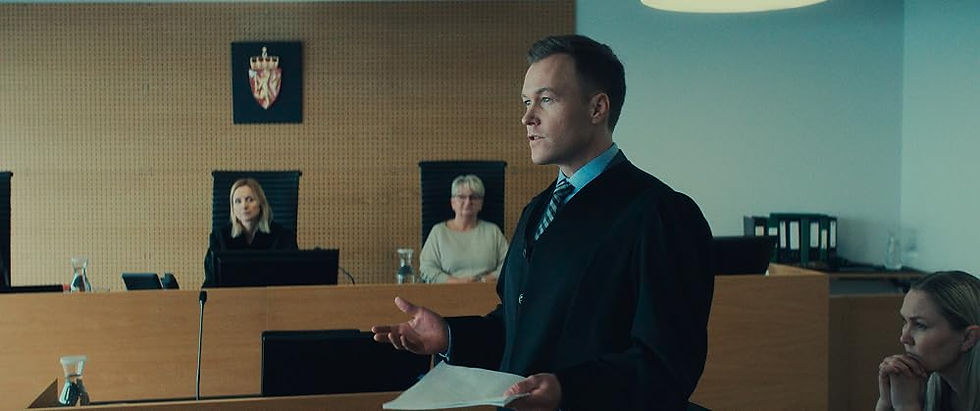
From the start, the Gheorghius are portrayed as meek, devout Christians whose religiosity is, at worst, a little anachronistic and weird. The children proselytize to their neighbor friends in a matter-of-fact way, and seem to genuinely respect their parents’ rules.Elia is slightly more willing to break them than her brother, but all in all, their cohesion is apparent and presented as harmless.
Meanwhile, the grey-and-blue hued Scandinavian society they’ve entered is portrayed as progressive in the extreme: CPS is called when Judith, the youngest Gheorghiu daughter, tells a lesbian classmate that her sexual orientation goes against God’s will. Meanwhile, the Norwegian CPS representatives and trial prosecution are relentlessly smug and their arguments and statements border on implausible (see: one of the foster parents claiming they feel as close to the Gheorghiu kids as a biological parent would). Mungiu’s finger is so clearly on the scale here, which delegitimizes any notion that this film is a good-faith attempt to approach issues of child abuse, parenting, religion, the larger cultural moment that we’re living in, or anything else Fjord purports to be about.
The fact that the Gheorghius are evangelical Christians is a very telling decision. Romanians are overwhelmingly Eastern Orthodox Christians, with Protestants being a very small minority (Evangelicals being an even smaller portion of that). In Europe, however, Evangelicalism doesn’t come with the same baggage that it does in the US, and I suspect that the Gheorghiu family’s Evangelicism is a calculated choice on Mungiu’s part, based on how he wants this movie to be received by Western audiences and awards bodies.

It’s certainly not too calculated, though, as the Gheorghius participate in Lent (not an Evangelical practice), and so the fact of the film’s grab-bag version of Christianity undermines any faith the viewer has in Mungiu to portray any of this realistically (again, the portrayal of Norwegian CPS is incredulous). But if this is going to be a big important film about capital-I Issues and gets liberal, educated, American audiencesgoing, better for the Gheorghius to be part of a Christian sect that takes up more cultural space. It’s also my experience, as someone who is Romanian Orthodox and grew up in that community, that Orthodox people (at least the liberal ones) aren’t so rigid, and are pretty normal about most things, an inconvenient reality for what Mungiu wants to accomplish with this film.
Aim and audience are intertwined here. The film already won the Palme d’Or and thus the legitimacy of the elite European arthouse crowd. Now onward to the next theater of this campaign: America. And who better to preach to than the foremost gathering of Romanian-American professionals? What better target audience?
I am not good at masking my disdain for these professional conferences and what they exemplify. Although there was some thoughtful programming on topics like immigration or biotechnology, much of the conference was dedicated to business and AI and their intersection. During the Q&A portion of the “How Will AI Agents Rewire Businesses” panel, a young college student studying to be a software engineer asked the speakers what they should do to make sure they couldn’t be replaced by AI. The response: “Don’t worry about it.”
I was gobsmacked by such an uncritical perspective, but I know where it comes from. Everyone in that room was an affluent, white-collar worker who had come to America and made the “American Dream” work for them (or their parents, or grandparents, and so on). Of course an issue like AI and its impact on employment is going to go unexamined, because all that a student has to do is work hard around it – the same way their parents worked hard, the economic reality of the situation be damned.
It's this type of person that is the ideal audience member for Mungiu’s new film. An Oscar win for Romania would be massive (Best International Feature Film, perhaps, although if a child of Romanian immigrants came home with that, their parents would ask “Why not Best Picture?”). It would be a point of pride for Romanian-Americans who need to prove they can make it in America.

Many Romanian-Americans are somewhere in the middle politically – their experiences under Ceausescu do not endear them to the left, nor do they push them to an American right whose overt oppression echoes that of Romania’s secret police. They don’t condone the right, but also believe that woke can go too far. Sure, the Gheorghiu family rallying online conservative Christian groups to their cause is a little unsavory, but look at how Child Protective Services treats them! If that’s not Fjord in a nutshell…
Scratch this facade of neutrality, this “enlightened centrism,” and you’ll find a view of the world that ultimately aligns with the right. Fjord is for an audience that wants to pat itself on the back and feel smart for seeing both sides, no matter what the actual reality of a sensitive and crucial issue is, and is tailor-made for the awards body that gave Best Picture to Green Book (2018).
-Nick


Comments