An Interview with Adrian Chiarella and Joe Bird, Director and Star of ‘Leviticus’

Updated: Aug 2
Horror is having a moment. Between Curry Barker’s gleefully cruel box office sensation Obsession and Kane Parsons’ expansion of his YouTube-roots liminal horror project Backrooms, the genre is exploding. Another player has stepped up to bat.

Adrian Chiarella’s queer horror film Leviticus comes at the peak of summer and amidst a rising tide of bigotry in the West, including Australia, where Chiarella is from and where the film was produced. Australia’s One Nation movement espouses much of the same bigotry that Donald Trump does stateside. These movements aggressively position queer and trans people as punching bags to instill fear and hate in their bases. There is a parallel rise in right-wing Christian nationalism that demonizes LGBT+ people and uses religion as a crutch on which to lean while spewing vitriol, demonstrated clearly by certain states’ efforts to reinstate conversion therapy since Trump’s re-election.
It is in the idea that queer and trans people will ultimately give in to societal pressure and “fix” the error of their ways that Leviticus proffers its horror concept: an invisible creature that latches onto queer people, as manifested by a deliverance healer. Once brought forth, this creature will present itself as the person one most desires. For Naim (Joe Bird), Ryan (Stacy Clausen) and Hunter (Jeremy Blewitt), a trio of gay high schoolers, this could mean the end of both their lives as they wished – and their lives as they know it.
While in San Francisco to screen the film for Frameline50, I sat down with Chiarella and Bird to talk about the film’s production, origins and time it's coming out in.
The following interview has been edited for clarity and brevity.
AUGUST HAMMEL: Happy opening weekend and happy Pride.
ADRIAN CHIARELLA: Yes, happy pride!
AH: Well, pleasantries out of the way: you guys gave me nightmares last night.
AC: Oh!
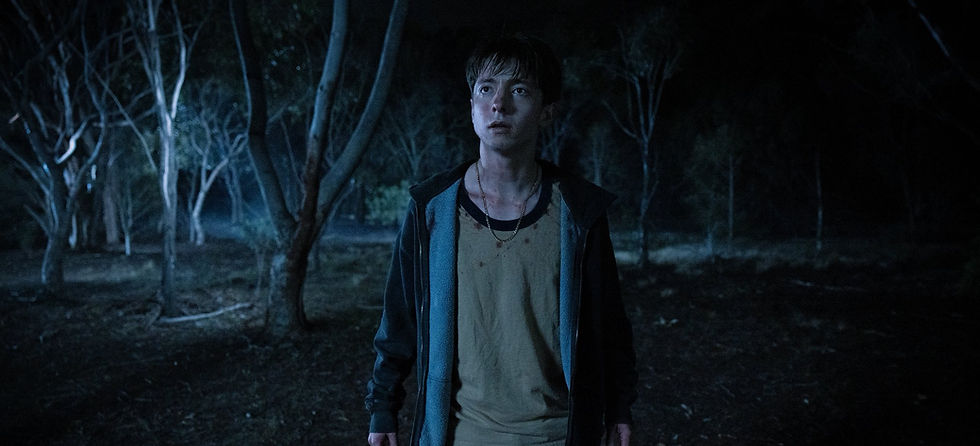
AH: I saw it at the Roxie [Theater], it was a great screening. How did you two bond before shooting? [Adrian], how did you approach Joe? And Joe, how did you approach the script and working with Adrian?
JOE BIRD: I was filming a short film the week before this job. When I found out I got the role, I would call Adrian randomly and just talk about life, not even about the job, because I just wanted to build this connection with Adrian. When it came up to production, we were already pretty tight. It was because Adrian was just really open to hearing what I had to say. He's just such a great director and person.
AC: Joe loves to share a lot and likes to ask about other people's lives. Joe's got a real curiosity, which I think is such an important part of being a good actor, so we just had a lot of conversations about both of our experiences. That went for a few months, didn't it? I still remember at the first audition, you said I couldn't look at you because I kind of knew at the callback that, “Oh, I'm pretty sure Joe's going to be the one we cast.” I was worried he'd just tell.
JB: I’d read [for] him and he didn't look at me and I was like, “Great, I didn't get the role, I’m just going to go to bed and never get out of it!” But I'm so glad that obviously didn’t happen.

AH: You did get the role! [Adrian], what was your first idea of the film, whether it was an image or a sound or a concept, and [Joe] what was your first impression of the script once you got it?
AC: I knew I wanted to do a horror movie about homophobia, but I wanted to start with this relationship between these two young men, and I think the very first scene I did was the one where they were looking at the snake. It was a much, much longer dialogue scene – as with all script writing, it was very overwritten – but it was necessary, I think, to really explore who these two characters were.
JB: Receiving the script for the first time, I got the script right before the in-person final callback. When I was reading it, I couldn't put it down. It was just so engaging, first of all. Second of all, it was really raw and authentic. I could tell the amount of time and passion that had gone into the script, which I know would reflect on who Adrian was as a filmmaker, which also got me excited. These characters on this page were all so multifaceted and had so much depth. I was obsessed, and I was like, “I can't not do this.”
I found Adrian's email somehow and I sent him a letter of all this stuff that I was thinking and how it made me feel and whatnot. I just thought, as a director, you’re going to care if an actor has passion in something that they've created. So I'm really glad that I did end up sending that. I don't know whether it influenced anything, but... Yeah!
AH: You mentioned the scene with the snake at the opening [of the film] – it's eating a toad. [The film is] called Leviticus and in the Bible, the toad represents uncleanliness. The movie, in general – I don't want to label [it] as anti-religion – but it takes this anti-forced belief position, exploring the dangers of beliefs that are forced upon people. How did you approach that, and was that something that was crucial to the script as you were writing it or did you find that as you went along?

AC: You know, the book of Leviticus is probably one of the most controversial books of the Bible when it comes to interpretation, and the way I like to think of the film is not so much as anti-religious, but more of a commentary on how we interpret these beliefs and these ideas that are thousands of years old, and what we do with those beliefs and what we do with that interpretation in our modern lives. So that's the place that I think the film comes from when it does comment on religion.
We did borrow a lot of imagery from the Bible and from the book of Leviticus: there's that goat that turns up all over the place, and yes, the snakes. There's also something for me, particularly the first half of the film, this story of jealousy and betrayal, and it's like one of those very ancient parables. I really tapped into that when I was plotting out the story.
AH: Joe, similarly, the opening scene reflects [how] the movie is such a tonal balance between drama and horror, and they kind of intermingle. How do you, as an actor, keep that throughline of a character without ever feeling like you're dipping your toe too far into one genre? Because you do feel like the same character throughout, just in extreme circumstances.
JB: I think horror is really grounded in realism and this script had coming-of-age, romance, drama [and] horror all living together, so it wasn't necessarily like this film was one genre and you had to act in that genre. It felt real and authentic and I think that speaks to the performances. It was just about building these connections with these other characters, and if that was real, then the audience hopefully can care about these people to produce that feeling.
AH: Australia and America are both experiencing this spike in right-wing nationalism and right-wing political movements. You have the One Nation movement that's growing in size right now. Was that on your mind as a filmmaker and on your mind as an actor?

AC: Yeah, that was absolutely the jumping-off point for this film, that a lot of our rights for our LGBT+ community seem to be peeling back. I wanted to do something about that and make a film that commented on that, but in a different way [from] what we'd seen before and in a more personal way for me.
JB: This world every day, we do get more progressive, but we also get more un-progressive.
It's maybe one step forward, two steps back. I just think that a film like this does exist in this world now so that we can try and spread awareness on these issues and these themes and that, hopefully, whether people like the film or not, that they just understand what we're trying to say.
Leviticus is now playing in select theaters.
-August


Comments