The Abiding Moon in Lee Chang-Dong’s ‘Possible Love’

When I sat down in the cinema to watch Lee Chang-dong’s newest film, Possible Love, I knew nothing about its story or even its genre. And frankly, I did not mind at all. Boasting an extraordinary seven-feature run since 1997, the Korean director has long since accustomed me to trusting that I am safe in his hands. I was vaguely aware that the film centered on two couples, but eight years after the enigmatic work that is Burning (2018), I had no idea that his latest would share so many points of connection with the most recent project from another great name of the Korean New Wave: Park Chan-wook.

It is true that Chan-wook’s No Other Choice (2025) leans more into its dark humor and audacious cinematographic style than what we see in Possible Love, yet both grapple with parallel deep-rooted concerns. In each story, a male protagonist has built his life around a clear, settled structure, so that when his connection to the company is severed, it is not merely a matter of losing work, but of losing his standing as a man, his sense of purpose, and his very identity. Both are profoundly family-minded, yet once they can no longer provide, and even though their wives stay with them, they carry a quiet, heavy shame that makes them ill-at-ease when meeting acquaintances who are still thriving. They are living in a world that no longer feels like it belongs to them.
Both films explore how losing one’s livelihood can destabilize personal worth and the families who depend on it, and how we must find renewed strength just to keep going. A double feature would be deeply rewarding: two outstanding works that speak to the same human truth through entirely distinct lenses.
Possible Love follows Ho-seok (Sul Kyung-gu), a man who has recently lost not just his income, but much of his pride, and his wife Mi-ok (Jeon Do-yeon). More than a foil to Ho-seok’s misfortune, Mi-ok is the one who bears the family through the crisis, carrying the weight of a life that might have been while striving to maintain an appearance of normalcy. Her past, which illuminates so much of her present, is gradually explored and revealed through Ye-ji (Cho Yeo-jeong), a filmmaker shooting a documentary about workers laid off en masse at SP Heavy Industries, in which Ho-seok’s family becomes the centerpiece.
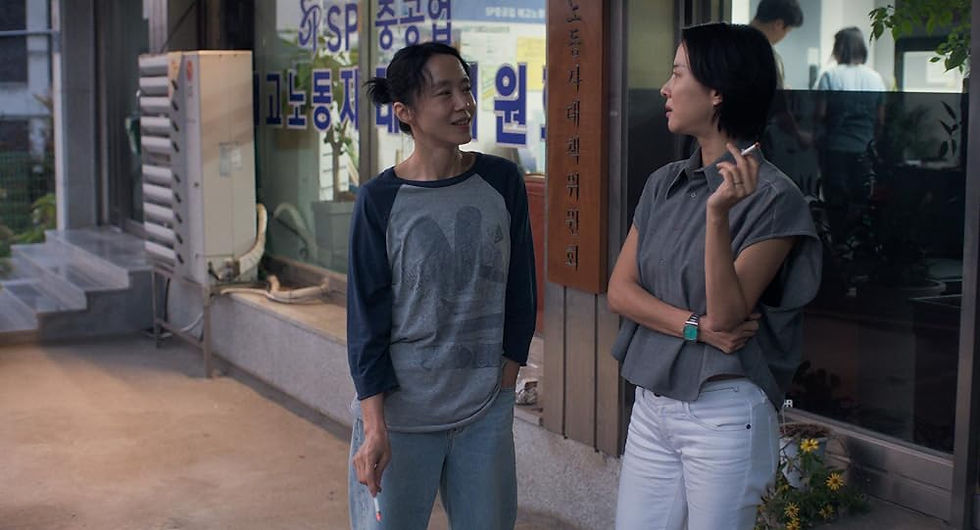
Rounding out the foursome is Ye-ji’s wealthy husband, Sang-woo (Zo In-sung), a businessman obsessed with closing his next big financial deal. As part of her effort to build a more personal relationship with the subject of her film, Ye-ji arranges meetings between the two couples, softening the voyeuristic dynamic into something that might pass for friendship. This all leads to a few days spent together at the affluent couple’s luxurious holiday home. It is here, in one of the first quiet moments shared between the two women, that the motif of the moon is first mentioned in conversation – the same moon that both women might have looked up to at the very same time, long before they ever met, even as they lived on different continents and experienced different lives.
I choose my words very carefully here, because shifting power dynamics and the contrasts between each character’s past and present run through every scene. Chang-dong handles these revelations with characteristic delicacy, grace and insight, guiding the viewers where he intends without us quite realizing where we are being led. Everything unfolds with apparent ease; some might even mistake this for narrative flatness, yet every choice serves a purpose. In one seemingly quiet moment, Mi-ok remarks on Ye-ji’s polished, expensive clothing, suggesting her attire sits uneasily alongside the people and circumstances she is documenting. This gentle accusation of being out-of-touch echoes later, as we watch the wealthy couple behaving in seemingly organic exchanges that only serve to widen the gap in income and circumstance between the two families.

As viewers, we may find it uncomfortable how Ye-ji, for all her warmth and apparent closeness, never forgets to turn the camera on what is shared in confidence. It is no wonder that Mi-ok at times feels laid bare, observed not as an equal but as a subject. However, we know Lee Chang-dong does not deal in simple heroes and villains; no one is perfect, no one is evil. Everyone has their place, sees something they covet in the other, and knows when to keep their cards close. In what is surely one of the year’s best scenes in 2026 cinema, Mi-ok’s metaphorical exposure becomes, by her own choice, physical nudity – a reclamation of her body as an act of freedom and self-possession. Here, she is in control; she finds power, she feels desired, and thus she offers something of herself that the other party can never truly access, just as they have demonstrated a status and wealth she may never attain.
From an acting standpoint, the four performances are of the highest calibre. Sul Kyung-gu delivers what is nothing short of an Oscar-worthy scene when he finally lets sing the resentment for life’s unfairness, up to which point he has proudly harbored. Yet it is the two women who carry the film as its brightest stars. Both radiate naturalness and realism, and each fits their character perfectly.

Cho Yeo-jeong takes on a role that bears notable similarities to her part in Parasite (2019), and once again plays it to perfection: she creates a full-bodied, lived-in figure who feels like someone we have known far beyond what we see on screen. Jeon Do-yeon carries not only the weight of her family, but also the same quiet power we witnessed in her earlier work with Chang-Dong in Secret Sunshine (2007). She turns every ounce of suffering into strength, so that rather than merely pitying her circumstances, we come to admire the extraordinary resilience. They are two legends who deserve all the flowers!
I am loathe to give away plot details, but beyond the understated contrasts drawn between the two households, I also really appreciated how the film shows us the more humanistic side: that beneath all our differences, we share so much. One night, Mi-ok and Ho-seok’s son wakes, and through his eyes we see a tender karaoke scene unfold, wherein the two couples seem closer than ever, without any gap in social status, having slipped gracefully back into youth. Chang-dong again returns to the horizon to highlight the moon, that distant, magnetic mass that shines on all of humankind. In the end, whatever we manage to achieve in this life, we all carry the same hopes, fears, triumphs and failings under the same sky.
- Pedro


Comments